India's 742 million strong rural population, outsizing the US and Europe, is moving towards branded products. Education for women is more than a politician's promise; it's a marketer's delight. Television, cable TV and FMCG products have penetrated the south far more than any other region in India. Ashok Das, MD, Hansa Research says, “Penetration driving strategy better for east and north, while for south the question is how to get value from consumer already using your product and brand.
Sunday, August 20, 2006
Reliance to invest $5 billion in Rural India
Accroding to this news:
Reliance plans to invest $5 billion by 2011 to put both the farms and the stores on the road to modernity, connect them through a distribution system guided by the latest logistics technology, and create enough of a surplus to generate $20 billion in agricultural exports annually.
Rural India corners chunk of industries, jobs
Who says economic reforms are urban-centric? The countryside has outperformed urban India in the number of enterprises it houses. Over 61% of the enterprises engaged in economic activities other than crop production and plantation are in rural India compared to just 38.7% in urban areas, according to the figures of the Fifth Economic Census.
Low-cost ATMs for rural India : IIT Chennai invention
According to this news:
Grammteller, unlike other ATMs is meant to be a cash dispenser, which plugs into a kiosk PC, which acts as a tunnel between the dispenser and the bank server thus bypassing use of the 'switch' used by ATMs. The 'financial transaction switch' is an enterprise server that connects the ATM to information from various sources, which then dispenses with the switch, thus reducing the cost of the machine to about Rs. 50, 000. The server is encrypted and runs on a proprietary format developed at IIT-M.
Unlike the PIN numbers log-in access facility, Grammteller is equipped with biometric sensor so that once the customer's fingerprints are registered, PINs need not be used.
Aimed at the rural market, the low-cost ATM makes it more user-friendly for people in rural India who are more into 'finger impression' mindset for taking cash. The thumb-impressions are being registered at the TeNet Lab at IIT-M and are stored and authenticated by ICICI servers in Mumbai.
Good links on Rural India - 2
Please see the first set of links.
K-yan : An e-learning system developed by IIT Mumbai for Rural
WiMAX is good for rural India : Key players in the market are Alcatel, TI, Motorola
Idea launched Mobile PCO services for Rural India
Tarahaat: Network of franchised rural communities and business centres
Highest paid occupation for men in Rural India is Masonry
Telemedicine - Providing Rural India with Quality Healthcare
India innovators foundation to help grassroot innovators in finding investors
Hansdehar is the first village in India to have an official website along with complete its citizens details
Nowpos to offer voice mail services for rural
Tata-Teleservices and ZTE corporation to deploy CDMA2000 in Rural India
3G mobile services to Bridge Rural-Urban Digital Divide
Rural India skips the copper wire and heads straight for wireless networks
Stockholm Competition : IT solutions for the benifit of masses
NTPC lamps to light up rural India
Cellphones answer the call for computers in rural India
K-yan : An e-learning system developed by IIT Mumbai for Rural
WiMAX is good for rural India : Key players in the market are Alcatel, TI, Motorola
Idea launched Mobile PCO services for Rural India
Tarahaat: Network of franchised rural communities and business centres
Highest paid occupation for men in Rural India is Masonry
Telemedicine - Providing Rural India with Quality Healthcare
India innovators foundation to help grassroot innovators in finding investors
Hansdehar is the first village in India to have an official website along with complete its citizens details
Nowpos to offer voice mail services for rural
Tata-Teleservices and ZTE corporation to deploy CDMA2000 in Rural India
3G mobile services to Bridge Rural-Urban Digital Divide
Rural India skips the copper wire and heads straight for wireless networks
Stockholm Competition : IT solutions for the benifit of masses
NTPC lamps to light up rural India
Cellphones answer the call for computers in rural India
Rural schools helping students to get into IITs, Olympiad events
Past few days, this news from Bihar is in top headlines: Ramanujan School of Mathematics helping rural students to get into IITs. Bhaskaracharya Pratishthana in Pune also helps students to get into IITs and Mathematics Olympiad events. Similarly in Kolhapur in Maharashtra, some ignited minds do help rural students.
This should be an eye opener for the people who think reservations are necessary.
This should be an eye opener for the people who think reservations are necessary.
Low cost wireless mesh network to provide cheap, reliable data and telephony
A former Silicon Valley dot-commer and members of the underground security group Cult of the Dead Cow are working with local Tibetan exiles to change that using recycled hardware, solar power, open-source software and nerd ingenuity. The volunteers are building a low-cost wireless mesh network to provide cheap, reliable data and telephony to community organizations. A rural village 7,000 feet up in the Himalayas (Dharamsala Wireless Mesh) is an example of "light infrastructure," a concept gaining popularity among tech developers: decentralized, ad hoc networks that can deliver essential services faster than conventional means.
Can this be a solution for rural India?
Can this be a solution for rural India?
Wednesday, July 26, 2006
Women Development : Problems and Solution perspectives
From my childhood I used to get trained to be fearless and take initiatives by myself. My parents and society around me made sure that I can walk on this world as an independent person. Psychologically whenever I am under pressure, depression etc, then my parents, relatives, friends, colleagues, teachers, villagers, news-papers, TV, other media etc everyone and everything on this list made me to think courageously and move forward in life. This kind of severe training I got it for at least 15 years of my whole childhood life and because of which now I feel strong and think way beyond.
On the other hand, I see that every girl-child around me get trained (during the same period of her life) to feel fear to go out, not to take any initiatives on her own and most importantly not to become an independent person in this world. I am extremely surprised to see that, and very unfortunate, even every mother also trains her girl-child to feel fear & inferior. This is the way, this male dominated society makes women to feel insecure thro various ways and means.
Is there any logic behind this:
Are women weaker than their counterparts, physically?? I don’t answer this but then: Definitely they can’t be weaker than a physically disabled man and in any case assuming there is a weaker person, then society should attempt to make him/her feel courageous but not to teach "how to feel insecure". In fact, society attempts the brave lessons for a physically disabled person but not for a woman. Why??
If you look at society closely: Women are taught to be inferior to Men. Which is nothing but women growth potential is upper bounded by Men. Because of this, our economy gets hurt very badly. Economists count the women while calculating GDP per capita but then society does not give fair opportunities so that they can contribute their part to GDP. Just think this: if we can make women (constituting nearly half of the population) part of GDP then we can achieve GDP growth rate 15%.
Solution perspective:
It is a plain and simple fact that howsoever weak a person is: but if he/she is powered with knowledge then nothing limits them. Of the late, knowledge based revolution is taking place and in this upward society everyone bows to knowledge and “just” to it. So it does not matter whether one has muscle power or not and in fact, it does not matter whether one is physically abled or not. Importantly, this revolution has been bridging the gap between the developed economies and developing economies. All those same advantages of developing economies which made that to happen are very much applicable to traditionally suppressed communities like women, caste based or religion based downtrodden, etc.
Business Perspective:
People who convert the social problems into opportunities are known as social entrepreneurs. In our case, examples are already set. Like Mahesh Bhupati who invested his money on Sania has clicked. Koneru Hampi is another example. Now such investments are required. Though it takes longer time for returns from this type of investments but then these have enormous potential to become multiples.
People who convert the social problems into opportunities are known as social entrepreneurs. In our case, examples are already set. Like Mahesh Bhupati who invested his money on Sania has clicked. Koneru Hampi is another example. Now such investments are required. Though it takes longer time for returns from this type of investments but then these have enormous potential to become multiples.
I have very clear-cut & very practical solutions for this problem. But then very few women, who believe that they are not upper bounded by men, should join this mission (ya, you can say Charlie’s Angels :-) ). So why this attempt of mine.
General request to all:
I hope you all realise this difference that is taking place (knowledge revolution). I request you all to engage in this important discussion so that thousands years of suppression problems get solved.
There is a community in Orkut for this purpose. For the readers, who does not know Orkut: it is a friendship network service of Google (similar to Myspace) and it needs an invitation to start an account. Community is like a yahoo group but discussions are public. If you would like to join this community, then you must have an Orkut account, for which you require an invitation. So you may write to me with all your details for an invitation (my gmail id: malapati). Link to the community: http://www.orkut.com/Community.aspx?cmm=17172270
I hope you all realise this difference that is taking place (knowledge revolution). I request you all to engage in this important discussion so that thousands years of suppression problems get solved.
There is a community in Orkut for this purpose. For the readers, who does not know Orkut: it is a friendship network service of Google (similar to Myspace) and it needs an invitation to start an account. Community is like a yahoo group but discussions are public. If you would like to join this community, then you must have an Orkut account, for which you require an invitation. So you may write to me with all your details for an invitation (my gmail id: malapati). Link to the community: http://www.orkut.com/Community.aspx?cmm=17172270
Saturday, June 03, 2006
Microsoft and Rural Development
I think, many people have doubts that how they can do rural development activities when they go for work in posh corporate offices or research institutes and having no time for their own family. For them, here is a good news.
Microsoft recently opened a R&D center in Bangalore. So what's is up, for rural developers?
They work broadly in the area of Technology for Emerging Markets.
Current Projects:
Software Data Collection for Rural PC Kiosks
Ethnography of Rural Kiosks
Urban Consumption Patterns in India
Text-Free User Interface
Computers in Agriculture
Computers in Education
Featherweight Computing
Telemedicine
Information Environment of Micro-enterprises
Mapping household well-being and socio-economic mobility
Household credit and investment decision-making
Hurry-up for summer internships, temporary research collaborations and ofcourse, for regular research positions.
Microsoft recently opened a R&D center in Bangalore. So what's is up, for rural developers?
They work broadly in the area of Technology for Emerging Markets.
Current Projects:
Software Data Collection for Rural PC Kiosks
Ethnography of Rural Kiosks
Urban Consumption Patterns in India
Text-Free User Interface
Computers in Agriculture
Computers in Education
Featherweight Computing
Telemedicine
Information Environment of Micro-enterprises
Mapping household well-being and socio-economic mobility
Household credit and investment decision-making
Hurry-up for summer internships, temporary research collaborations and ofcourse, for regular research positions.
Tuesday, April 25, 2006
Some good links on rural
The Nordic Council of Ministers is inviting applications for sustainable development grants.The deadline is 1 May.
Recently I wrote about "poor prefer private education". Here is a report that poor do get more benifit from private schools than their counter-parts.
According to a survey of egovernance projects, IT seems to be making higher impact in rural India compared to urban India. More details can be seen here.
Pico-hydro power generation is, a pilot project, to meet the energy needs of small communities in the hilly areas in Nepal (funded by UNDP).
INTERACT project (Sustainable Groundwater Management in Rural India) is a collaborative effort of several Indian research institutes with funding from UK's EPSRC. This research work is to enhance competitiveness in the field of Geoenvironmental Engineering, Sustainable groundwater management and Public Health issues.
Last year I wrote about Intel's project related to dust-free PC. Now Via technologies, with the support of IIT Bombay, developing a computer that can withstand erratic power supply and the heat and dust of rural places.
Recently I wrote about "poor prefer private education". Here is a report that poor do get more benifit from private schools than their counter-parts.
According to a survey of egovernance projects, IT seems to be making higher impact in rural India compared to urban India. More details can be seen here.
Pico-hydro power generation is, a pilot project, to meet the energy needs of small communities in the hilly areas in Nepal (funded by UNDP).
INTERACT project (Sustainable Groundwater Management in Rural India) is a collaborative effort of several Indian research institutes with funding from UK's EPSRC. This research work is to enhance competitiveness in the field of Geoenvironmental Engineering, Sustainable groundwater management and Public Health issues.
Last year I wrote about Intel's project related to dust-free PC. Now Via technologies, with the support of IIT Bombay, developing a computer that can withstand erratic power supply and the heat and dust of rural places.
Cheaper 'blackberry' type gadget for rural india
Motorola (thro project at IIT Bombay) and Microsoft (independently) are developing a communication device using which "one can receive and make calls, check mails and use data services".
Rural India's market size in 2020 : $ 500 billion
Mckinsey recently surveyed rural India for Bharat Nirman project and concluded that rural India's market size in 2020 would be US $ 500 billion. According to survey: Of the 593 rural districts in India, 67 were classified as urban cousins, 118 close to rural economic centers, around 160 with basic minimum infrastructure and 248 are deprived.
Monday, April 10, 2006
Are you taking note of Green-Tech future?
According to this news:
Kleiner Perkins [Venture Capitalist firm] plans to set aside $100 million of its latest $600 million fund to technologies that help provide cleaner energy, transportation, air and water. "This field of green-tech could be the largest economic opportunity of the 21st century," Doerr said. "There’s never been a better time than now to start or accelerate a greentech venture."
Kleiner Perkins’ plan to ramp up investment in green technology is just the latest sign of the new sector’s growth. Also known as clean technology, the field includes technologies related to water purification, air quality, nanotechnology, alternative fuels, manufacturing, recycling and renewable energy.
North American venture capitalists invested more than $1.6 billion in clean-tech companies last year, a 35 percent increase over 2004, according to a report by the Cleantech Venture Network.
Wednesday, March 29, 2006
Water-Cycle : a grass-root innovation
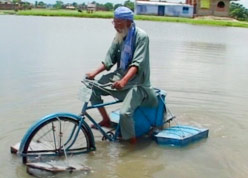
I wrote previously about grassroot-innovations in India. Left side photo is about one of such inventions, a bicycle that can not-only travel on land but can also float on water.
Food processing: Big corporates romancing with Rural India
According to this news:
My question is : will this move make sure that farmer gets benifited more than now?? Hope so.There are big plans being drawn up to link India’s farms to the world markets by companies, particularly those venturing into the domestic retail sector like Reliance, Godrej, Field Fresh (Sunil Mittal’s 50:50 joint venture with Rothschild), Snowman Frozen Food, a joint venture with the Mitsubishi group, Amalgam foods and HLL, Radhakrishna Group, DCM Sriram, Gufic Labs, Jain Irrigation, Tata Group, Godrej, Dabur, Blue Star and Voltas, among others.
Tax incentives being given by the government for food processing, including income tax and excise holidays for industries involved in the processing of fruits and vegetables have led to interest in the sector. These companies are establishing direct contact with farmers to source their requirements, by eliminating middlemen, and cutting down costs to offer higher yields to farmers.
Saturday, March 25, 2006
Are you a rural entrepreneur seeking funds?
Aavishkaar funds rural ventures that are commercially viable, improve the quality of life in rural people and needing Rs. 1 million to 5 Million. Check its website for more details.
Innovative distribution model for renewable energy in Bangladesh
According to this news:
With a loan in the form of a program-related investment (PRI) from The Lemelson Foundation, Emergence Energy is testing micro-entrepreneurship models for energy production and distribution in Bangladesh. Led by Iqbal Quadir, founder of Grameen Phone, and Dean Kamen, an accomplished inventor, Emergence Energy will combine access to micro-credit with low-cost energy generation technology to test whether rural entrepreneurs can sustainably manage mini power plants at the village level, making use of biogas and the stirling engine.
The proposed mini power plants will use cow manure as input and generate electricity, fertilizer, and heat as outputs. First, cow manure will be converted into methane-rich gas through a biogas business run by a local entrepreneur. This biogas will then be converted into electricity using a mini power plant owned and operated by two other entrepreneurs. All three entrepreneurs will be financed through a micro-credit program. These plants will generate a continuous power output of 1 KW and will supply energy for 70 advanced light bulbs, such as compact fluorescent lamps or light emitting diodes in their neighborhoods.
Friday, March 24, 2006
Deutsche Mutual Fund looking for companies focused on rural India
According to this news:
Deutsche Mutual Fund plans to turn its attention to companies focused on rural India, courtesy an equity fund titled Deutsche Green India Fund. The proposed scheme will try to generate long-term capital appreciation by investing chiefly in stocks of companies with businesses that revolve around the rural theme. These would also be companies that are expected to benefit from growth in agriculture and allied sectors. eutsche Green India Fund, to be benchmarked against the S&P CNX 500, will invest in companies engaged in agri commodities, irrigation, food processing, fertilisers, agri machinery, and the like.
Besides, rural infrastructure development companies (covering rural electrification, roads and canals) may also be included in the portfolio, along with tractor and two-wheeler makers. The fund's investment universe will include FMCG companies that derive a large part of their revenues from the rural market, while banks and finance outfits too will be taken into account. The offer document filed by Deutsche MF with the SEBI has named Vinay Kulkarni as the fund manager. A minimum 65 per cent of the assets will be invested in equities and equity-related securities of companies that focus on rural India. The allocation may be raised to 100 per cent as well.
Reliance Agri Fund, which Reliance MF had mooted last month, has been a first of sorts on this front although Sundaram MF has actually entered the market with its Rural India Fund. If launched, Reliance Agri will follow Reliance Equity, whose NFO recently wrapped up with Rs 5,700 crore. The fund's investments may span 0-100 per cent in equity as well as 0-100 per cent in debt. The idea, as outlined in the offer document, is to invest in equity or fixed income securities of companies in the agri sector and those in allied segments.
Thursday, March 23, 2006
Yahoo! India is eyeing rural India
According to this news:
Dr Prasad Ram, CTO, Yahoo! R&D India, said that `livelihood-based' offerings for the rural market would roll out by mid-2006.
Indian engineers [at Yahoo!] have contributed eight products to the global market. Three of them - Vertical Search, Personalised Anti-Spam Filters and Self Expression - were created, developed and completed here. While the first service offers Internet users the ability to narrow down their search in verticals such as travel, real estate, shopping and automotives, the second works on the premise that people have discrete definitions of spam. By studying their reaction to spam in their inbox, Yahoo! Mail will now be able to `learn' to minimise it using personalised filters. The third product, Self Expression, is a personalised Web page that will be "rich with self expression".. The company underwent a "rethinking of products" for rural markets. Dr Ram spoke about the probability of people in remote villages and towns adopting e-shopping, since they have limited access to shops. The company is presently undertaking the implementation rounds of the services. Pilot tests would begin in January, he added.
Development of rural enterprises -- China's secret
A book is edited by He Kang and written by experts in this field. According to this news:
This book details the rise and development of TVEs - a leading force that has propelled China's market economy forward, a vital pillar of the rural economy and an important component of the national economy.According to data contained in the book, the number of rural enterprises stood at more than 22.13 million, they employed more than 138.66 million people, making a great contribution to the national economic development and social stability. The book, in English and 436 pages, presents both a general picture and personal profiles of farmer-turned entrepreneurs, with detailed feature stories.
Well supported by a rich collection of data, graphics and statistics updated to 2004, easily accessible reference with well-indexed names and terms peculiar to China, the book is considered suitable for researchers into the Chinese economy, especially that of rural China, Chinese farmers and agriculture, as well as for anyone who wants a peep at the secrets of China's rapid economic growth.
Title of the Book: China's Township and Village Enterprises
Publisher: Foreign Languages Press, Beijing
Monday, March 20, 2006
Rural Indian been running a radio station and seeking help
According to this news:
Everyone is hooked to Raghav Station in a dusty village in the eastern Bihar, one of India's most backward and impoverished states. The radio station, hugely popular with the residents of Mansoorpur - a non-descript village in Muzaffarpur district, is the brainchild of a local youth Raghav Kumar.
Twenty-two-year-old Kumar, a self-taught radio mechanic, can hardly read and write, but all the programmes on his radio station have struck a chord with the local residents for the past three years. Kumar's passion for doing something creative and unique has remained undeterred by his illiteracy and poverty.
Kumar has ingeniously fitted his transmission kit - a box strung to antenna to a bamboo pole connecting at least three tape-recorders in his thatched-roof repair shop stacked with over 200 audio tapes and electronic appliances. The station plays folk songs and popular Bollywood music. It also broadcasts public interest messages on polio and HIV on requests from social organisations - all without charging a single penny.
The station's popularity has clearly given other FM channels a run for their money within the 15 km radius of Kumar's shop. Everyone listens to the Raghav Station. We take the radio along when we go to work in our fields and listen to the songs while working. Our families also listen to the songs, says Ram Prasad Bhagat, a villager.
The indigenous radio station, however, has yet to find favour from the government, as it has no statutory licence to run such a station. Kumar says with his meagrely monthly income of 2000 rupees (US dollars 45), he cannot pay the registration fees. Kumar seeks government aid to help him register his station and to acquire some advanced equipment to transmit the radio waves to a greater distance.
Everyone is hooked to Raghav Station in a dusty village in the eastern Bihar, one of India's most backward and impoverished states. The radio station, hugely popular with the residents of Mansoorpur - a non-descript village in Muzaffarpur district, is the brainchild of a local youth Raghav Kumar.
Twenty-two-year-old Kumar, a self-taught radio mechanic, can hardly read and write, but all the programmes on his radio station have struck a chord with the local residents for the past three years. Kumar's passion for doing something creative and unique has remained undeterred by his illiteracy and poverty.
Kumar has ingeniously fitted his transmission kit - a box strung to antenna to a bamboo pole connecting at least three tape-recorders in his thatched-roof repair shop stacked with over 200 audio tapes and electronic appliances. The station plays folk songs and popular Bollywood music. It also broadcasts public interest messages on polio and HIV on requests from social organisations - all without charging a single penny.
The station's popularity has clearly given other FM channels a run for their money within the 15 km radius of Kumar's shop. Everyone listens to the Raghav Station. We take the radio along when we go to work in our fields and listen to the songs while working. Our families also listen to the songs, says Ram Prasad Bhagat, a villager.
The indigenous radio station, however, has yet to find favour from the government, as it has no statutory licence to run such a station. Kumar says with his meagrely monthly income of 2000 rupees (US dollars 45), he cannot pay the registration fees. Kumar seeks government aid to help him register his station and to acquire some advanced equipment to transmit the radio waves to a greater distance.
Sunday, March 19, 2006
Rural Employment Scheme : yet another political gimmick
Recent proposal : National Rural Employment Guarantee Scheme by the current government is a mere political gimmick. This is another scheme which increases the appetite of already-corrupt-administration. Rural youth require jobs creation but not wastage of public money like this.
You may see more detailed analysis : Atanu Dey, Economic Times, Business Today.
You may see more detailed analysis : Atanu Dey, Economic Times, Business Today.
Mutual Fund is after companies focussing rural
According to this news:
Related news: Khosla interested in companies serving rural
Sundaram Mutual Fund has unveiled its new equity offering under open-ended category, Sundaram Rural India Fund.
The primary investment objective of the scheme is to generate consistent long-term returns by investing predominantly in equity & equity related instruments of companies that are focusing on Rural India.
The new fund offer opens on March 20, 2006 and will close on April14, 2006. Minimum subscription amount is Rs 5,000 and offers both dividend and growth option. During new fund offer it would not charge any entry load while an exit load of 3 per cent would be levied if redeemed within six months from the date of allotment.
Related news: Khosla interested in companies serving rural
Thursday, March 16, 2006
Hyderabad university admits school drop-outs
Please see this news. Hyderabad University train school drop-outs so that they can be viable for industry.
No rain but vegetables can be grown : IIM prof feat
According to this news:
Vegetables growing in arid land is unheard of. But this impossible task has been made possible by IIMA professor Dr Girija Sharan. For the past three years, people of Kothara village in Kutch enjoy fresh tomatoes and capsicums grown at a greenhouse farm here. Now, even nearby areas including IAF base at Nalia come here for their greens.Raja
The credit goes to Dr Sharan who designed the Arid Area Greenhouse (AAG), a cultivation technology that departs from the traditional open farms and makes use of the greenhouse’s controlled enviroment to grow vegetables in a place where water is scarce.
Tuesday, March 14, 2006
Khosla : Looking for investments in sustainable technologies
Vinod Khosla is looking to invest into energy, micro-finance and bottom of the pyramid among others. See his new exclusive venture fund for this.
This is a great news for social entrepreneurs in India.
Raja
This is a great news for social entrepreneurs in India.
Raja
Monday, March 13, 2006
Poor parents prefer private schools: Why?
This survey research paper answers the following interesting question.
Q. Why would these largely poor parents pay for their child’s education when there is a free government alternative?
1) The private schools are having English medium which is a very important factor to the 96% of the parents.
2) Parents perceive that the private sector provides a better quality of education
3) 98% of the parents indicate the fact that the school is considered to be a ‘good educational provider’ is an important element when they chose their child’s school.
4) Almost 75% of the parents stated that it was unimportant to them if there was a government alternative to which they could send their children They would choose the private school irrespective of the provision of a government school.
5) 78% of the parents stated that they would recommend their current private school to their neighbours, friends or relatives.
6) 93% of the parents rated their private school “very good” or “good” value for money.
7) School owners face 3 or more major competing schools in their area. Local government school is never a competitor. (most owners expressed this!)
8) School official: the teachers in the private unaided schools are accountable to the parents. On the other hand, govt schools teachers and staff are guaranteed a ‘job for life’ owing to the strength of the teachers’ unions and employment contracts.
9) Parents are attracted to private schools glossy brochure and the manager’s office had marble floors and air conditioning ( however class-rooms are no different in schools which charge less or high).
10) ‘Recognised’ by the state Government (thro bribery: even this fact is known to parents).
11) Internal tests in private schools were deliberately providing easier tests to inflate their scores, thus encouraging parents to believe that they were better.
Q. Why would these largely poor parents pay for their child’s education when there is a free government alternative?
1) The private schools are having English medium which is a very important factor to the 96% of the parents.
2) Parents perceive that the private sector provides a better quality of education
3) 98% of the parents indicate the fact that the school is considered to be a ‘good educational provider’ is an important element when they chose their child’s school.
4) Almost 75% of the parents stated that it was unimportant to them if there was a government alternative to which they could send their children They would choose the private school irrespective of the provision of a government school.
5) 78% of the parents stated that they would recommend their current private school to their neighbours, friends or relatives.
6) 93% of the parents rated their private school “very good” or “good” value for money.
7) School owners face 3 or more major competing schools in their area. Local government school is never a competitor. (most owners expressed this!)
8) School official: the teachers in the private unaided schools are accountable to the parents. On the other hand, govt schools teachers and staff are guaranteed a ‘job for life’ owing to the strength of the teachers’ unions and employment contracts.
9) Parents are attracted to private schools glossy brochure and the manager’s office had marble floors and air conditioning ( however class-rooms are no different in schools which charge less or high).
10) ‘Recognised’ by the state Government (thro bribery: even this fact is known to parents).
11) Internal tests in private schools were deliberately providing easier tests to inflate their scores, thus encouraging parents to believe that they were better.
Packaged Rural Foods & a business plan
For the past 10 years, I usually carry hot (Namkeen or Junk Food) (I also carry sweets, but this article is limited to hot varieties) made in my home to my university. Whenever I took such items, all of my friends greatly enjoyed over and above sweets. Till date, I have never seen such wide varieties of items in any city I stayed in India (Chennai, Kolkata, Mumbai). I had at least 100 different tasty foods in my own home. And I believe there could be even more items.
Usually these foods are made of rice (main ingredient) (rarely wheat), Dals (pulses), masala chilli powder and some other stuff. Good part of them is that they stay for longer without any preservatives (longer I mean, more than 3 months if packaged).
There is a good market for such items in India and elsewhere in the world. In India, there are very few companies in this domain notably Haldiram. However haldiram's business is limited to few items (10-15 types : and all are not much different in taste).
Rural India can do a lot in this space. In fact, there are some similar packaged items in Japan originating from rural places of Japan.
Raja
OSP India Information Security Private Limited
Usually these foods are made of rice (main ingredient) (rarely wheat), Dals (pulses), masala chilli powder and some other stuff. Good part of them is that they stay for longer without any preservatives (longer I mean, more than 3 months if packaged).
There is a good market for such items in India and elsewhere in the world. In India, there are very few companies in this domain notably Haldiram. However haldiram's business is limited to few items (10-15 types : and all are not much different in taste).
Rural India can do a lot in this space. In fact, there are some similar packaged items in Japan originating from rural places of Japan.
Raja
OSP India Information Security Private Limited
Wednesday, March 01, 2006
Who is an entrepreneur?
Today (1st of March, 2006) is one of my happiest days in my life. Reason : I just could understand who a entrepreneur is!! Yes .. I got the real sense of it.
Whenever a person feels a frustation because of a service/facility unavailability, that is the oppertunity to be to be grabbed. If one grabs so he will be called as entrepreneur.
Provide a service which makes people get out of their frustation and that will make you an entrepreneur.
Yes .. I wish & I will become a social entrepreneur through which I will change the lives of bottom most of the pyramid.
Raja
OSP India Information Security Private Limited(OSP Global, LLC)
Whenever a person feels a frustation because of a service/facility unavailability, that is the oppertunity to be to be grabbed. If one grabs so he will be called as entrepreneur.
Provide a service which makes people get out of their frustation and that will make you an entrepreneur.
Yes .. I wish & I will become a social entrepreneur through which I will change the lives of bottom most of the pyramid.
Raja
OSP India Information Security Private Limited(OSP Global, LLC)
Monday, February 13, 2006
Sphere packing and my vision of rural development
Many people asked me about my approach to rural development. Here I dont give what exactly is my plan but vague description of the net-result that I expect to happen after my efforts.
Sphere Packing: I read this concept about in my coding theory course. It is a very interesting concept. However now, I wish to explore it to our concern.
Problem: Imagine a room and you are asked to fill the room with various sizes of balls (spheres) so that all the space in the room is filled-up.
Now I see this problem in another manner, room is my nation. Radius of each of those spheres (balls) is the community of people who work for social development cause. And their access is the sphere volume. So now the problem is restated as:
Problem: Increase the communities working for social development so that they cover the entire nation.
Raja
OSP India Information Security Private Limited (OSP Global, LLC)
Sphere Packing: I read this concept about in my coding theory course. It is a very interesting concept. However now, I wish to explore it to our concern.
Problem: Imagine a room and you are asked to fill the room with various sizes of balls (spheres) so that all the space in the room is filled-up.
Now I see this problem in another manner, room is my nation. Radius of each of those spheres (balls) is the community of people who work for social development cause. And their access is the sphere volume. So now the problem is restated as:
Problem: Increase the communities working for social development so that they cover the entire nation.
Raja
OSP India Information Security Private Limited (OSP Global, LLC)
Sunday, February 12, 2006
Social Entrepreneurs : drivers for economy in rural areas
Here is a report on six social entrepreneurs, who bear witness to the fact that profit is not the only driver of innovation.
Raja
OSP Information Security Private Limited (OSP Global,LLC)
Raja
OSP Information Security Private Limited (OSP Global,LLC)
Transparent delivery for Government Schemes in Rural India
As ET reports :
Self Help Groups (SHGS) are today considered the answer for the transparent delivery of a host of government schemes, from education to credit. But SHGs are no different from the state’s much touted and now discredited cooperative credit societies.
The SHG channel for delivery of credit especially in the rural areas and the Nabard’s preference for this channel are well known. However, a note of caution is also being sounded. “What is the difference between a credit society and an SHG? This is new wine in an old bottle since group dynamics play in both cases.
Credit societies have shown their unsustainability. Inn future, politicians could use them as a forum for exploitation,” Porwal stated.
He was speaking at the Nabard’s state credit seminar here. Supporting Porwal’s stance, S C Basu, chairman and MD, Bank of Maharashtra, said the farmer needs support from multiple agencies. While SHGs have been eulogised everyhwere and are successful now, there is a need to look if there are any inherent defects in them.
Thursday, February 02, 2006
Low cost technologies : Rural India powered
One of my post discusses, how rural Indians without formal education could innovate low cost technologies. Here is another news that low-cost lamps brightening the rural India.
"Rural Access Service to Internet" is a low-cost tech project in rural tamilnadu to install tele-kiosks, to offer more than 60 services, including those relating to agriculture, education, healthcare, utility and entertainment.
Raja
OSP India Information Security Pvt Ltd
"Rural Access Service to Internet" is a low-cost tech project in rural tamilnadu to install tele-kiosks, to offer more than 60 services, including those relating to agriculture, education, healthcare, utility and entertainment.
Raja
OSP India Information Security Pvt Ltd
Rural India : Heaven of Oppertunities even for biggies
Microsoft & Oracle etc have got their eye in right direction. What Prahlad wanted to convey is all about this only. As you look at the downwards of the pyramid, volume speaks. That is, fortune at the bottom of the pyramid.
Now rural India is going to enjoy the timely information provided by companies of social motive : Drishti, Jaikisan and n-Logue. Microsoft does "software daan" to these companies & moreover it will also provide technical support to the rural youth in this pioneering initiative. On the other hand, Oracle is also vying for rural India. Then our Godrej is betting on rural India by pouring money, billions of Rupees.
Raja
OSP India Information Security Private Limited
Now rural India is going to enjoy the timely information provided by companies of social motive : Drishti, Jaikisan and n-Logue. Microsoft does "software daan" to these companies & moreover it will also provide technical support to the rural youth in this pioneering initiative. On the other hand, Oracle is also vying for rural India. Then our Godrej is betting on rural India by pouring money, billions of Rupees.
Raja
OSP India Information Security Private Limited
Sunday, November 13, 2005
Rural Kiosks model to spread internet in Rural India
According to this news:
Raja
OSP India Information Security Private Limited (OSPGlobal, LLC)
Drishtee.com Ltd, plans to deliver the government and other services to villagers through ICTs. They rely on the enterprise of local entrepreneurs supported by a central organisation and ICT infrastructure. Improving services to villages and increasing the economic viability of rural entrepreneurship through proprietary arrangements with the governments to provide services at lower than government costs are some of the stated aims. Its basic objective is to sensitise and promote the usage of ICT kiosks among users and the outside stakeholders. It advocates the need of basic accountability, timely reporting and spreading general awareness about new economy.I think, this project has a huge potential if the model is properly implemented. This is very similar to governments knowledge centre concept (or Abdul Kalam's PURA). However, as there is a wonderful business, so govt's role should be limited to service provider. I mean, Govt services should become add-ons to the total project. Govt should invest in educational issues, family planning, similar social issues. But it should not focus on setting-up the infrastructure. Otherwise, whole efficiency of this project may become a question. I am very happy that once ignored market of rural India is now a hot market and this fact has been realised by truly global players. So now changes will be rapid.
It has two roles: to expand and build the network and to sell services through the kiosks which it sets up. A kiosk is a multi-point service delivery channel in a village. The kiosk operator provides different kinds of services to villagers like computer education, insurance, digital photo studio and the Internet-based services. The kiosk is equipped with a computer, a digital camera and a photo printer. This project is in partnership with ICICI, Microsoft, Amaron. Advantage to ICICI is that it can offer financial products and services such as loans, investments and insurance through these kiosks.
Raja
OSP India Information Security Private Limited (OSPGlobal, LLC)


Every Village a Knowledge Centre : Mission 2007
According to this news:
Raja
OSP India Information Security Private Limited (OSP Global, LLC)
With its grand Mission 2007 project, the Chennai-based M.S. Swaminathan Research Foundation plans to promote rural prosperity by focussing on an information and knowledge-led rural economy. Their dream of rural prosperity is all set to materialise in the current decade, thanks to the formation of a national alliance to make every village a knowledge centre by 2007 and the launch of Mission 2007 to achieve this goal.
The national alliance, which began with 40 members, now has over 100 partners, including government departments, public sector enterprises, industrial houses, philanthropic bodies, NGOs and international development agencies. The village knowledge centres will be organised and managed by ICT-based SHGs and NABARD is expected to provide Rs.1 lakh as loan to each centre. A cadre of one million grassroots level fellows would be created and they would function as the torchbearers of the knowledge revolution. Other key aspects to receive attention include gender mainstreaming of content, assured and remunerative market-linking of producers and purchasers, outsourcing of work from towns to villages, fostering SHGs and organising technical, financial and infrastructure resources.
Raja
OSP India Information Security Private Limited (OSP Global, LLC)
The hidden wealth of the rural poor
According to this news:
OSP India Information Security Private Limited (OSP Global, LLC)
Raja
Financial services are at last spreading from the rich to the developing world—and even making money. In rich countries, financial services on the whole work remarkably well, despite the exotic salaries, the crackpot deals and the occasional bust. By contrast, financial services for poor people in developing countries—a business known as “microfinance”—have mostly been awful or absent so far.
At present, nobody knows how many institutions are providing microfinance in some form, but the number is certainly increasing. They are growing fast and serving a vast number of people in absolute terms, although still only a small proportion of the billions who earn only a few cents a day. Local banking giants that used to ignore the poor, such as Ecuador's Bank Pichincha and India's ICICI, are now entering the market. Even more strikingly, some of the world's biggest and wealthiest banks, including Citigroup, Deutsche Bank, Commerzbank, HSBC, ING and ABN Amro, are dipping their toes into the water.
OSP India Information Security Private Limited (OSP Global, LLC)
Free Computers for Rural Communities and select individuals
Recent announcement of AsiaTotal.net, a Hongkong based firm, unveils a very new business concept. It is planning to offer computers absolutely free for rural folks (even to NGOs, individuals, small rural companies, etc) of Latin America, China, India, Russia, Continental and Eastern Europe, South Africa, Mexico, the Philippines and West Asia.
Although it has not received media attention as expected, but I believe it will be a sensational news within few days.
First of all, is it a viable business model? Although Ms. Chen (CEO, Asiatotal.net) is silent in this regard, some curious observers predicted the following.
If it succeeds, we will see radical changes in society towards computing. Which, in turn, means that we have seen only a fraction of IT revolution till date. I do hope so irrespective of practicalities.
Although it has not received media attention as expected, but I believe it will be a sensational news within few days.
First of all, is it a viable business model? Although Ms. Chen (CEO, Asiatotal.net) is silent in this regard, some curious observers predicted the following.
This model could work -- but it might be difficult to attract the required sponsorship. Some Russian companies might be willing to pay up to $10 per computer annually to attract users from the targeted demographic to their sites. If Asiatotal.net could attract such companies for each of the 10 buttons, it would earn $500 over the maximum lifespan of the average PC, more than covering the cost of the lowest PCs currently on the market.On the negative side, observers feel:
We do not see any lock-in value for the sponsor as the user may not use these keys at all. Coupled with this, the PC is connected to the internet through dial-up modems, when most of the internet connections now available operate on the broadband route.Will it explode like 1GB free e-mail service or it busts like FreePC which attempted to distribute 10000 compaq machines in 1999?
If it succeeds, we will see radical changes in society towards computing. Which, in turn, means that we have seen only a fraction of IT revolution till date. I do hope so irrespective of practicalities.
Raja
OSP India Information Security Private Limited (OSP Global, LLC)
Tuesday, November 08, 2005
African farmers share traditional knowledge
According to this news:
Raja
OSP India Information Security Private Limited (OSP Global, LLC)
Such a program can very well be replicated in India.Farmers in Tanzania and Kenya are developing sustainable crop protection strategies — and spreading the word when they hit on a solution which works for them. When they observe positive results in the field, they spread the message via radio programmes, printed materials and traditional music and drama, so that farmers in other districts can try similar tactics. The initiative is part of the UK Department for International Development Crop Protection Programme. The programme builds on farmers’ traditional knowledge, adding scientific knowledge about pests, diseases and weeds and options for their management. In Tanzania’s Singida district, peasant farmers have been helped to develop traditional crop protection methods against seed-eating birds, mainly queleaquelea, as an alternative to expensive and damaging agrochemicals. They use traditional early warning information on the migratory patterns of the birds.
DFID Crop Protection Programme
Park House
Bradbourne Lane
Aylesford
Kent ME20 6SN
UK
Fax: +44-1732 220498
Email: f.kimmins@nrint.co.uk
Raja
OSP India Information Security Private Limited (OSP Global, LLC)
Sunday, October 30, 2005
New vibrant India upbeats on agri-preneurs
According to this news:
Terra Firma, a government of India-recognised agricultural training centre, has mooted what it calls Farmer's World, a supermarket chain to be run by agriculture graduates who have trained to become agripreneurs.
It is being jointly promoted by Small Farmers Agri Business Consortium, a society under the union ministry of agriculture.
Farmer's World will be a one-stop shop selling all farm produce under one roof.
The ultimate aim is to provide job opportunity to at least 5,000 agriculture graduates, who will be linked with each other.
The entrepreneurs can place their order with the central hub and get delivery within 24 hours through a transport network being organised by Terra Firma.
The central hub will help in creating a farmers' input (seeds, fertilisers, bio-pesticides) supply chain, render marketing and other services required by farmers and the agripreneurs, act as an information kiosk and impart technical know-how and extension service.
Each local centre will be constituted as a private limited company, with agriculture graduates as its directors. The initial cost of each centre will be Rs 80 lakh {Rs 8 million (estimate made by SFAC)}.
The agripreneurs will contribute Rs 800,000 as promoter's equity, National Bank for Agriculture and Rural Development will give a subsidy of Rs 20 lakh (Rs 2 million) under a programme of the National Horticultural Board, SFAC will provide a venture capital loan of Rs 12 lakh (Rs 1.2 million) at zero per cent interest, which is payable after the repayment of bank loan, and a term loan of Rs 40 lakh (Rs 4 million) will be raised from commercial banks.
Leading banks such as ICICI Bank, Vijaya Bank, HDFC Bank, Canara Bank and Syndicate Bank have come forward to finance these projects. Over and above all this, the state agriculture and horticulture department will provide up to 20 per cent subsidy.
Terra Firma is presently conducting a market study and logistics survey and hopes that the network will be in place within six months.
The company will act as a nodal agency, identifying and training entrepreneurs, conducting market surveys, preparing the detailed project report for each centre and help in setting up the centres and monitoring the scheme. "We act as a service provider.
Terra Firma expects that each entrepreneur will make a business turnover of about Rs 2 crore (Rs 20 million) annually, on which it plans to charge service fee of about 2-3 per cent. "This will not be a permanent arrangement. It is not compulsory for them to rely on our support,"
See complete news here.
Saturday, October 15, 2005
Visit rural Kerala to search for grassroot innovators
National Innovation foundation (NIF) is engaged in finding out rural innovators and help them with business practices of their inventions.
"Shodh yatra" mean : A Collective walk through the rainforests to learn from the creative communities and individuals.
16th shodh yatra will be held in Kerala (an Indian state known as "a Gods own country") during the end of december, 2005. More details can be seen here.
Raja
OSP India Information Security Prvate Limited (OSP Global, LLC)
"Shodh yatra" mean : A Collective walk through the rainforests to learn from the creative communities and individuals.
16th shodh yatra will be held in Kerala (an Indian state known as "a Gods own country") during the end of december, 2005. More details can be seen here.
Raja
OSP India Information Security Prvate Limited (OSP Global, LLC)
Vacancies in NIF
National Innovation Foundation is the path breaking organization in supporting grass-root innovators of Rural India.
Currently NIF is looking for professionals (with aspiration towards rural development). Find more details here.
Raja
OSP India Information Security Prvate Limited (OSP Global, LLC)
Currently NIF is looking for professionals (with aspiration towards rural development). Find more details here.
Raja
OSP India Information Security Prvate Limited (OSP Global, LLC)
Friday, September 23, 2005
Rural development course with scholarship 21000 Euro pa
M.Sc. program in Rural Development is offered in Europe with a scholarship of 21000 Euro per annum.
Please find more details on this course here.
Raja
OSP India Information Security Prvate Limited (OSP Global, LLC)
Please find more details on this course here.
Raja
OSP India Information Security Prvate Limited (OSP Global, LLC)
Monday, August 29, 2005
Economic Times upbeats on Rural Development
It is a wonderful news. Vinod Khosla (Co-Founder Sun Microsystems) has acted as guest editor for India's top news paper "The economic times".
Being one of the topmost venture capitalist of the world, he edited news on every aspect in regards of business oppertunities exist in this forgotten land.
August 29, 2005 issue carries completely on Rural development issues. I think every invester, activist, economist, businessman etc should see this issue.
Some of the headlines:
700 million Indians (Rural population)
India Inc crops up or Moolah Rouge
Home in on warehouses
Companies roam the countryside
WiMAX: Getting maximum from your telephone
Villages getting a healthy dose of telemedicine
They all are in the net
Rural POs to be one-stop service shops
Plough cosies up to the keyboard
This is one GM that’ll be the boss (GM- Green Revolution, Gene revolution)
and MANY MANY MORE ....
Please see those news here.
Raja
OSP India Information Security Prvate Limited (OSP Global, LLC)
Being one of the topmost venture capitalist of the world, he edited news on every aspect in regards of business oppertunities exist in this forgotten land.
August 29, 2005 issue carries completely on Rural development issues. I think every invester, activist, economist, businessman etc should see this issue.
Some of the headlines:
700 million Indians (Rural population)
India Inc crops up or Moolah Rouge
Home in on warehouses
Companies roam the countryside
WiMAX: Getting maximum from your telephone
Villages getting a healthy dose of telemedicine
They all are in the net
Rural POs to be one-stop service shops
Plough cosies up to the keyboard
This is one GM that’ll be the boss (GM- Green Revolution, Gene revolution)
and MANY MANY MORE ....
Please see those news here.
Raja
OSP India Information Security Prvate Limited (OSP Global, LLC)
Wednesday, August 24, 2005
IT to villages
According to this news:
Department of Information Technology (DIT) of India has identified certain key priorities in this area (IT to villages).
The first-the creation of core common infrastructure in terms of State Wide Area Networks (SWANs) for providing connectivity, National/State Data Centres for reliable and secured data and Common Services Centres (CSCs) for delivery of Services.
DIT has already announced guidelines for providing supports to the States for the establishment of SWANs. Out of 30 states, 17 have shown keen interest in implementing this project, Maran said. Some of the states have already been financially supported under the SWAN scheme, which has an outlay of Rs.3,334 crore.
An empowered committee on SWAN has been constituted with Secretary (IT) as Chairman and members from Planning Commission, Ministry of Finance, National Informatics Centre and DIT. The committee has already considered SWAN proposals from 14 states and approved Rs. 1027.63 crore. Out of this, Rs. 206 crore, which is 20 percent of approved outlay, have already been released.
Raja
OSP India Information Security Private Limited (OSP Global, LLC)
Department of Information Technology (DIT) of India has identified certain key priorities in this area (IT to villages).
The first-the creation of core common infrastructure in terms of State Wide Area Networks (SWANs) for providing connectivity, National/State Data Centres for reliable and secured data and Common Services Centres (CSCs) for delivery of Services.
DIT has already announced guidelines for providing supports to the States for the establishment of SWANs. Out of 30 states, 17 have shown keen interest in implementing this project, Maran said. Some of the states have already been financially supported under the SWAN scheme, which has an outlay of Rs.3,334 crore.
An empowered committee on SWAN has been constituted with Secretary (IT) as Chairman and members from Planning Commission, Ministry of Finance, National Informatics Centre and DIT. The committee has already considered SWAN proposals from 14 states and approved Rs. 1027.63 crore. Out of this, Rs. 206 crore, which is 20 percent of approved outlay, have already been released.
Raja
OSP India Information Security Private Limited (OSP Global, LLC)
Dust Free PC for Rural
According to this news,
Intel announced plans to supply emerging countries with a new PC made specifically to tolerate hot and dusty conditions. It has showed a demo PC of such.However it still does not support Indian hot weather. I wonder what would be its cost?? However Indian Simputer and AMD's 50x15 are competetive products to this Intel's dust-free pc. Although late, but it is good that large corporates see the Rural areas as viable market. So we can see some competetion and in a way cost gets down which makes low end user happy.
Raja
OSP India Information Security Private Limited (OSP Global, LLC)
Tuesday, August 23, 2005
New technology to help remote areas access the internet
According to this news:
RURAL AND remote areas in the United Republic of Tanzania may soon have access to reliable internet connectivity thanks to a newly introduced information technology.The technology is a positive development for many remote communities which are beyond the reach of communications infrastru cture, reliable internet connectivity, access to libraries, and interaction with other users through e-mail.
The new technology uses satellite communication, which provides a uniform level of service to all communities re gard less of their location.
The technology includes a central hub facility, internet backbone connectivity, and fully indep e n d e nt classroom, intra-class computing facilities, training programmes for administrators and teachers, and an education portal.
The education portal provides a single point of interaction with dynamic information, applications, processes and people. The satellite link will enable any community to have access to high quality education materials from national, academic, medical and law libraries, regardless of where it is located.
Raja
OSP India Information Security Private Limited (OSP Global, LLC)
Sunday, August 07, 2005
IDOL vs ICON : Real Problem
see below for definitions of idol & icon in this context.
In India, if someone does a bit extraordinary in any 'one field' then he becomes " IDOL". On the other hand, in the other part of the world, such person becomes "ICON".
I mean the 'problem' is: people go by blind faith in regards of any field without any constructive criticism (because he was successful in just one field).
That is why: APJ Kalam, Jayalalitha, Gandhi, Amitabh, vivekananda, Sachin, Buddha, RajaniKanth,Ambedkar, NTR, Shirdi Saibaba, etc. became IDOL.
Nitin interpreted this problem as:
'person/personality' overshadowing the 'essential value', glorifying former than the later .. whereas it should have been otherwise..
Although this problem exists in other part of the world but it is close to fanatic in the case of India. Congress has been able to sustain in century long politics due to demiGod status of Gandhi, Nehru, etc.
Amit's guess is, this is due to, we lack "ego", a sense of self, self-importance, self-respect, and confidence. Thus, we tend to submit everything to authority pretty quickly. We see someone successful in one field and want to raise him/her to a padestal.
My opinion: I partly agree with him, it is due to the lacking of inquisitive reasoning. More clearcut solutions/reasoning are invited.
--------------------
What is ICON & IDOL ?? Nitin explains:
as used in present context, icon is an object/entity/individual that represents/symbolizes/expresses the epitomized/exemplified/exalted nature/idea of a action/value/belief/phenomenon
idol is an object/entity/individual that is a demigod (popularly considered).. an object of devotion (usually flawed sense of devotion) ..
dr.kalam is an icon as indian citizen/scientist, and only that
meryl streep is an icon of 'acting' as an art, and only that
amitabh is an icon of indian cinema/acting, and only that
Note: Nitin and Amit are friends of mine.
Cricket does wonders!
Over the years and in particular from past few days, I am hearing the following statement. I am serving India by watching cricket. If I am hearing from someone who is not educated then I would n't have cared at all but from highly learned people. So after giving a little thought, I would like to mention somegreat things of this game: (if u know some more, let me know!)
(As of my knowledge) Cricket is the only TV program in the world which can make viewers sit before a TV for continuously for more than 8 hours. For this, I think it should get into Guinese Book of Records.
Cricket does another wonder: A poor country like India (and that too, poor citizens of it) are encouraging a sport in developed countries like UK, Australia, NewZealand. Players/cricketing body in those countries are directly/indirectly funded by India's poor citizens. Unfortunately those countries dont ever acknowledge and we dont care because we dont even know this fact.
Many people feel that they do not pay any money to cricket just by watching it. Unfortunately by watching cricket means: watching thousands of Ads and thus making a room to thousands of companies so by paying money for all those ads costs, companies, cricket board and players. For example, Lays chips is known for its innovaive brading via cricketing media. Cost of manufacturing a chip packet between 1 Rupee and 2 Rs. But it sells for 20/-. All the rest is paid by the consumer goes where, need not be mentioned. Similarly we pay Pepsi or cola 10/- while manufacturing cost is about 40 or 50 paise. A country where people do not afford (or intend) to buy milk but can buy a pepsi (which is even double costlier than milk). No politician (while discussing score of cricket in parliament) ever bothered about the fact that poorest Indian citizen spends hard cash on cricket (may be earned by shedding his blood).
Why our govt offices work very slow need not be mentioned. It is due to laziness gifted by watching cricket for hours to hours. Bank officers to Engineers to Parliamentarians to Teachers are bothered about how the score is progressing but not on their profession.
Many todays' so called educated people believe that India is now developing and will become "Super Power". This is because many surveys indicate that India has 50% young people and young means growth for spurring the economy (unfortunately while projecting growth rate, Mckinsey misses the lazy people, who are created by our great game). No one ever try to think that how hard is to keep up the current pace of growth and we even think, it is just as easy as watching for 8 hours continuously (fanatically for 5 days) and have a discussion about India's growth.
Raja
(As of my knowledge) Cricket is the only TV program in the world which can make viewers sit before a TV for continuously for more than 8 hours. For this, I think it should get into Guinese Book of Records.
Cricket does another wonder: A poor country like India (and that too, poor citizens of it) are encouraging a sport in developed countries like UK, Australia, NewZealand. Players/cricketing body in those countries are directly/indirectly funded by India's poor citizens. Unfortunately those countries dont ever acknowledge and we dont care because we dont even know this fact.
Many people feel that they do not pay any money to cricket just by watching it. Unfortunately by watching cricket means: watching thousands of Ads and thus making a room to thousands of companies so by paying money for all those ads costs, companies, cricket board and players. For example, Lays chips is known for its innovaive brading via cricketing media. Cost of manufacturing a chip packet between 1 Rupee and 2 Rs. But it sells for 20/-. All the rest is paid by the consumer goes where, need not be mentioned. Similarly we pay Pepsi or cola 10/- while manufacturing cost is about 40 or 50 paise. A country where people do not afford (or intend) to buy milk but can buy a pepsi (which is even double costlier than milk). No politician (while discussing score of cricket in parliament) ever bothered about the fact that poorest Indian citizen spends hard cash on cricket (may be earned by shedding his blood).
Why our govt offices work very slow need not be mentioned. It is due to laziness gifted by watching cricket for hours to hours. Bank officers to Engineers to Parliamentarians to Teachers are bothered about how the score is progressing but not on their profession.
Many todays' so called educated people believe that India is now developing and will become "Super Power". This is because many surveys indicate that India has 50% young people and young means growth for spurring the economy (unfortunately while projecting growth rate, Mckinsey misses the lazy people, who are created by our great game). No one ever try to think that how hard is to keep up the current pace of growth and we even think, it is just as easy as watching for 8 hours continuously (fanatically for 5 days) and have a discussion about India's growth.
Raja
(A diehard fan of cricket who could not resist to goto 2 KM distant railway station by walk whenever power was not avalable (to watch in a standing position)
Saturday, August 06, 2005
One of my plan for rural development
It is well known fact that if we start an usual NGO, then its scope would be very limited. I have been thinking on how to broaden my reach. I mean, my wish is to contribute to a large section of people (better, if beyond boundaries). Recently I had been to a village and during the conversation with villagers, I could understand that agriculture and traditional employment are only things they depend on. If these fail they just pray/leave to God. Now I could get a idea which is: practical, very cost effective, huge outreach, collective effort type and basically a long term project.
It is basically on "Self Employment Generation for youth".
I would like to create a database of different possible ways of self-employment generation and then convert the database into local languages.
Here, creating such database is crucial. To create such massive information, I would like to follow the footsteps laid down by Wikipedia and Linus Torwalds (creator of Linux). "Anybody can contribute" and it is expected to become a huge public effort (possibly across the globe).
This project has 4 stages.
1. Creating the software similar to Wikipedea, DMOZ, Free Software (Linux tools).
2. Requesting NGOs, other organizations, govt organizations, academic people, individuals to contribute for the database of the project (on their executed employment generation projects). Maintainance of such database.
3. Similar excercise for translation into local languages.
4. Requesting Individuals, NGOs and Govt organizations to consider this information.
why such project I would like to take up: because it is very cost effective. Investment is too less. It may help large section of people. Since broadband connection to >1000 villagers will be a reality very soon, then my thoughts make much sense. (For example Andhra will be broadband connected by end of 2007 : work is supposedly started).
If this project achieves partly success, immediately I would like to start on Agricultural methods, Teaching techniques (elementary and primary education), etc.
Comments/views/suggestions/fineTune thoughts or constructive criticisms on practical aspects of it, monetary benifits to society, etc are most welcome.
Raja
OSP India Information Security Prvate Limited (OSP Global, LLC)
It is basically on "Self Employment Generation for youth".
I would like to create a database of different possible ways of self-employment generation and then convert the database into local languages.
Here, creating such database is crucial. To create such massive information, I would like to follow the footsteps laid down by Wikipedia and Linus Torwalds (creator of Linux). "Anybody can contribute" and it is expected to become a huge public effort (possibly across the globe).
This project has 4 stages.
1. Creating the software similar to Wikipedea, DMOZ, Free Software (Linux tools).
2. Requesting NGOs, other organizations, govt organizations, academic people, individuals to contribute for the database of the project (on their executed employment generation projects). Maintainance of such database.
3. Similar excercise for translation into local languages.
4. Requesting Individuals, NGOs and Govt organizations to consider this information.
why such project I would like to take up: because it is very cost effective. Investment is too less. It may help large section of people. Since broadband connection to >1000 villagers will be a reality very soon, then my thoughts make much sense. (For example Andhra will be broadband connected by end of 2007 : work is supposedly started).
If this project achieves partly success, immediately I would like to start on Agricultural methods, Teaching techniques (elementary and primary education), etc.
Comments/views/suggestions/fineTune thoughts or constructive criticisms on practical aspects of it, monetary benifits to society, etc are most welcome.
Raja
OSP India Information Security Prvate Limited (OSP Global, LLC)
Wednesday, June 08, 2005
Rural Tours : A novel concept of rural-urban cooperation
I always believe that there is some gap between availabilities/pracical issues and rural people's knowledge. Some one has to bridge our type of ideas with people. It would be better if government does.
So I have been thinking about this bridge, by starting an organization which will make
a connection between rural and urban. I am calling it by name "Rural Tours". As u may guess by name, we take some company people to rural tour (sort of tourist visit). It is arranged from a city to a village during weekends. During the day time of the visit, they are expected to share their knowledge (to enrich the rural). Later in the evening, they are provided some tourist visit, cultural programs, can learn whatever rural are proficient at.
My ideas, vaguely drafted it for constructive criticisms on practical aspects of it, financial constraints (I may face), monetary benifits to society, etc. Please see this site and kindly give me your views.
http://www.isical.ac.in/~malapati_r/check.html
Update: After 3 years of my idea, similar venture is started in Bangalore. Please see it here.
So I have been thinking about this bridge, by starting an organization which will make
a connection between rural and urban. I am calling it by name "Rural Tours". As u may guess by name, we take some company people to rural tour (sort of tourist visit). It is arranged from a city to a village during weekends. During the day time of the visit, they are expected to share their knowledge (to enrich the rural). Later in the evening, they are provided some tourist visit, cultural programs, can learn whatever rural are proficient at.
My ideas, vaguely drafted it for constructive criticisms on practical aspects of it, financial constraints (I may face), monetary benifits to society, etc. Please see this site and kindly give me your views.
http://www.isical.ac.in/~malapati_r/check.html
Update: After 3 years of my idea, similar venture is started in Bangalore. Please see it here.
Saturday, May 28, 2005
Indian Villages may get Net, telephony on cable
According to this news:
Raja
OSP India Information Security Prvate Limited (OSP Global, LLC)
The Telecom Regulatory Authority of India is planning a convergence of voice data services.
It is expected to send a proposal to the government for allowing cable operators in rural areas to offer basic telephony and Internet services.
Trai is also to suggest a reduction in the licence fee and spectrum charges for rural cellular services. It is also proposed that Internet protocol-based telephony is permitted and the licensing structure amended, allowing broadband providers to offer voice services in rural India.
At present, cable operators like Hathway provide television channels and Internet browsing facilities in bigger cities. Unified licence holders like Bharti and Reliance can offer Internet, phone and cable services.
While service providers have not offered these three services together to landline subscribers, the services come packaged on high-end mobile phones.
The department of telecommunications is simultaneously initiating amendments to the Telegraph Act to let cellular operators have access to the universal service obligation fund. At present, the USO fund is available only to Bharat Sanchar Nigam Ltd for its fixed-line services in rural areas.
"The government has invested heavily in rural telephony and it subsidises the cost of the telephone instrument, but these have not produced the requisite results. We are working out models to force the rural market to proliferate".
Raja
OSP India Information Security Prvate Limited (OSP Global, LLC)
Thursday, May 26, 2005
A model village for Rural Development
Mr. Rajiv Shah has mailed me (also sent me a CD):
This was also programmed DD National Channel and a copy of which is with me. If anyone wishes, please send me a mail (malapati@google's mail)
Raja
OSP India Information Security Prvate Limited (OSP Global, LLC)
Near kolhapur I visited kambalwadi (near radhanagari in Maharashtra) in which, complete intergrated development program was implemented. it is wonderful... all in one village.. water conservation .. energy conservation, housing with total cleanliness,out of clutches of alcohol and tobacco, well done up roads, using only organic manure for crops, village women have docras and micro finance activities, implemented various gadgets for water supply without using electricity and oil purely on hydro technique, set up of WLL network by installing telecommunication tower. each house in village has a computer and school children are given all basic education. they have their own server like pabal village vidyan ashram which helps them to get connected with experts in agriculture and non farm sector. all houses are painted in one colour.
garbage management, proper drainage arrangements, after bodies are burned the ash and bones are used as organic manures in field, though it is isolated village in the corner of maharashtra on the foothills of sahyadri they have well done roads, plantation techniques for vegetable and alllied products, today village is independent and do not take power from mseb , do not take water from govt .. no funding is accepted from govt, they do not enertain govt officers as they say they do not need any govt programs, they have better health programs and connectivity for crtical cases, schools campus are well developed and maintained,taking wonderful results , they have adopted modern watershade magt technique and water harveting including rain water.. horticulture and afforestation activities at peak..all plants and trees are planted after considering flora and founa and natural bio diversity keeping balanced..no foreign treeslike nilgiri etc are planted only those which suits their environment and do not affect or pollute surrounding biology are planted. all court cases are withdrawn and handled by panchayat.
one of the ngo from kolhapur has taken pains to make it successful and many such independent villages are coming up. village women have their own programs with wonderfu earning.women empowerment in real sense. what else you need. their panchayat has offered me a place to come and stay with them...it was wonderful experience. another school at pachagaon at kolhapur a school of nomads have construed their own school bldg and all activities including maintainance of boarding school, organic manure, use of kitchen waste, natural cool house for keeping vegetables fresh and no of activities are carried out by these children.
Raja
OSP India Information Security Prvate Limited (OSP Global, LLC)
Friday, May 13, 2005
Apparel park empowers women of rural Andhra Pradesh
According to this news:
Raja
OSP India Information Security Prvate Limited (OSP Global, LLC)
Women in Samalkota of East Godavari district are abreast of the new trends in American fashion. The garments some 1,000 of them produce at an apparel park here will soon be available in the stores of global retail giant Wal-Mart and the outlets of Steve and Barry’s in the US and Setabis Textiles of Canada.Find detailed info here
"What is unique about this set-up is that women who work here are not employees but are employers," says Alla Umamaheswara Rao, managing director of EG Apparels. "They are stake-holders and thus are themselves profit centres."
The work at the park is outsourced to them from abroad through a Bangalore-based exporting unit. With this, Samalkota has joined the league of garment production centres like Bangalore, Chennai, Mumbai, Delhi and Gurgaon. "Soon we will start direct exports and 40 per cent of the profits will go to the employees," says Rao.
Raja
OSP India Information Security Prvate Limited (OSP Global, LLC)
Tuesday, May 10, 2005
Rural Innovations
National Innovation Foundation (India) in its website :
NIF's chanllenge is to link innovation, capital and enterprise. Its director, Gupta says, "We need mentors who can support these innovators. Most have no bank accounts. We need to give them design and marketing support, media coverage."
Find more innovations those can be marketed.
Raja
OSP India Information Security Prvate Limited (OSP Global, LLC)
"......the time has come to unleash the creative potential of our scientists and innovators at grassroots level. Only then we can make India truly self-reliant and a leader in sustainable technologies....propose a national foundation for helping innovators all over the country. This fund...will build a national register of innovations, mobilize intellectual property protection, set up incubators for converting into viable business opportunities and help in dissemination across the country.''Rural India is now in upswing with their creative innovations. Bicycle which runs on land as well as water. Washing Machine for Rs. 2000. What not!!
NIF's chanllenge is to link innovation, capital and enterprise. Its director, Gupta says, "We need mentors who can support these innovators. Most have no bank accounts. We need to give them design and marketing support, media coverage."
Find more innovations those can be marketed.
Raja
OSP India Information Security Prvate Limited (OSP Global, LLC)
Sunday, April 24, 2005
National Rural Health Mission
According to this news, the central govt announced the "National Rural Health Mission" in 18 states in the North and North-East. It has many interesting features (very decentralized; based on trained female health workers -- called Accredited Social Health Activists (ASHA) -- in each village; focus on comprehensive health (rather than specific diseases) etc. It looks like a very potent measure.
Also, the PM has said that the govt is committed "to raise health spending from 0.9 per cent of GDP at present to 2 per cent in the course of the next few years."
Raja
OSP India Information Security Prvate Limited (OSP Global, LLC)
Also, the PM has said that the govt is committed "to raise health spending from 0.9 per cent of GDP at present to 2 per cent in the course of the next few years."
Raja
OSP India Information Security Prvate Limited (OSP Global, LLC)
Saturday, April 23, 2005
ITC Rural Malls : shaping 21st century rural India
Drishti notes in his blog:
Raja
OSP India Information Security Prvate Limited (OSP Global, LLC)
Recently, ITC has launched the first rural mall-Choupal Sagar at Rafiqganj that is a little village about four kilometres from Sehore town in Madhya Pradesh. In continuation with its project e-Choupal, Chaupal Sagar is the first rural mall in the country andt stands on an eight-acre plot with a shopping area of 7,000 square feet.The farmers can buy soaps, detergents and toothpaste, almost everything they need for the family including TVs, DVD players, pressure cookers, room heaters, watches, sewing machines and grinders and, of course, cigarettes. Motorbikes or even tractors are also available. The company is marketing a new range of clothings and shoes too for the rural customers. And the plans are very ambitious. Starting in the first week of October, the daily sale is already between Rs 70,000 to 80,000- not bad as a business proposition too.
The idea is to create a one-stop destination for farmers. The farmer, with his family, drives into Chaupal Sagar in a tractor trolley laden with the produce from his field, he proposes to sell. His grain weighed on the digital weighing machine, he drives on to the godown where the produce is unloaded. Meanwhile, his kids can enjoy the swings and video games and his wife may like to move around and select the items she needs for the household. As soon as the farmer gets his cash, they make the required purchases and drive back by evening. They can, for a change, have their lunch in the cafeteria. If he intends to, he can even carry fertilisers and pesticides and get a diesel fill for his tractor.
Raja
OSP India Information Security Prvate Limited (OSP Global, LLC)
Monday, April 11, 2005
Brass containers prevent diseases : Indian traditional knowledge scientifically approved
According to rediff news, NATURE published an article on one of the Indian traditional ideas of water treatment and found a microbiological basis for it.
Indians believe that traditional brass water containers offer some protection against sickness. The idea, intrigued Reed (UK scientist) , who was in Asia (along with his Indian students) investigating the anti-bacterial effects of sunlight on water.
Indians believe that traditional brass water containers offer some protection against sickness. The idea, intrigued Reed (UK scientist) , who was in Asia (along with his Indian students) investigating the anti-bacterial effects of sunlight on water.
Sunday, April 10, 2005
Rural Technology Course at Vignan Ashram, Pune, India
A mail from Vignan Ashram:
Raja
OSP India Information Security Prvate Limited (OSP Global, LLC)
Admission for Diploma in Basic Rural Technology (DBRT) batch 2005-2006. We are always giving preference to the candidates coming from the NGOs :
1) Who wishes to start similar activity in their organisation.
2) Which are willing to do handholding for establishing the students as entreprenuer.
Next Batch of DBRT will start from 1st July 2005.
Duration : 1st July 2005 - 25th June 2006
Capacity : 24 nos. ( 20 boys + 4 Girls)
Fees. Rs.2500/- (Course fees) + Rs.6000/- (Food expenses) = Rs.8500/- (To be paid at the time of admission)
Eligibility : Min 8th std pass, Willingness to work by hand, enthusiastic, {Preference will be given to students from Tribal/Rural areas}
Syllabus : Students will be given training in the area of :
i) Engineering : Construction & Fabrication
ii) Energy - Environment : Electrical, Solar, biogas, Smokeless chulha, Motor rewinding
iii) Agri-Animal Husbandry : Agri, nursery techniques, Poultry, Goat Farming
iv) Home & Health : Rural Laboratory, Food products, Sewing etc.
students will spend 3 months in each section and will work with the instructors. He has to complete one project in each section. He has to learn computers for typing his reports and for giving presentation.
Contract work : For all the outside work orders received by ashram. Students will be given labour charge. It is necessary for the students to earn min Rs.1000/- by doing such work. It is expected that students should meet all his out of pocket expenses through his own earning.
Examination : National Institute Of Open Schooling conducts the exam and awards Diploma in BAsic Rural Technology.
Language : Marathi / Hindi
Admission criteria : First cum First basis
Prospectus : Please send Rs.25/- for prospectus and application form.
Please contact Sanjay Nimbalkar or Yogesh Kulkarni for more information.
Sanjay Nimbalkar
DBRT co-ordinator
Vigyan Ashram
At.Post. Pabal Dist.Pune 412403
Ph : 02138 292326
http://www.vigyanashram.com/
Raja
OSP India Information Security Prvate Limited (OSP Global, LLC)
Saturday, April 09, 2005
Rural Employment Guarantee Scheme
A legislation, Rural Employment Guarantee Act, is being enacted in Parliament. The Act will be the social safety net for the poorest in the rural areas.
This scheme guarantees that at least one person in a family gets work for 100 days in a year. If a person registers as unemployed and work has not been allotted for 15 days, he will be given minimum wages (as per state norms) since govt could not show him any work. Works may cover agro-processing, irrigation, on-farm processing, embroidery, weaving and printing.
This substantially will change the face of rural India. This project is estimated at Rs. 39000 crores, which is the 1% of the GDP.
I hope end user really benifits from this.
Raja
OSP India Information Security Prvate Limited (OSP Global, LLC)
This scheme guarantees that at least one person in a family gets work for 100 days in a year. If a person registers as unemployed and work has not been allotted for 15 days, he will be given minimum wages (as per state norms) since govt could not show him any work. Works may cover agro-processing, irrigation, on-farm processing, embroidery, weaving and printing.
This substantially will change the face of rural India. This project is estimated at Rs. 39000 crores, which is the 1% of the GDP.
I hope end user really benifits from this.
Raja
OSP India Information Security Prvate Limited (OSP Global, LLC)
Friday, April 08, 2005
Can rural India replace petrol?
According to this news, rural india can replace all petrol/diesel/gas in India just by having few cows/bullocks with each family.
Raja
OSP India Information Security Prvate Limited (OSP Global, LLC)
Raja
OSP India Information Security Prvate Limited (OSP Global, LLC)
Tuesday, April 05, 2005
Andhra Pradesh (Indian State) goes broadband
According to this news, the rural broadband network in Andhra Pradesh (Indian state) is an innovative and revolutionary project with three broad components:
Once if this project becomes alive then the face of AP village is set to change.
Raja
OSP India Information Security Prvate Limited (OSP Global, LLC)
- Electronic delivery of all government services to the people through 6,000 rural IT kiosks to be set up across the state. A team of specially trained rural women to be appointed through self help groups under the rural development department will run the kiosks.
- Computer literacy for at least one person in each family in all Andhra Pradesh villages.
- Broadband connectivity for all villages of Andhra Pradesh spread across the state's 2,75,000 square kilometers by December 2006.
Once if this project becomes alive then the face of AP village is set to change.
Raja
OSP India Information Security Prvate Limited (OSP Global, LLC)
Sunday, April 03, 2005
FMCG market is the next big thing in India
FMCG is the next big thing after IT, BIOTECH, REAL ESTATE, STEEL, AUTO .. Rural India will play a big role in FMCG market potential.
Raja
OSP India Information Security Prvate Limited (OSP Global, LLC)
Raja
OSP India Information Security Prvate Limited (OSP Global, LLC)
Subscribe to:
Posts (Atom)