Showing posts with label Grass Root Innovators. Show all posts

Monday, July 14, 2008

Rollable water container : an innovation for fun and need!


During my journeys to tribal locations (or broadly, rural), many times I fall into tears whenever I see many small children/ women carrying 2-3 water pots (one on top of another).  

Looking back at my childhood, rolling a cycle tube with a stick was a great fun. I used to run all over the village while rolling the tube whenever I find little time for playing. 

It appears that these two ideas are considered in inventing the following water container Q-Drum (patented) in order to fetch water. Of course, it is apparent that this is a natural invention considering that "Wheel" was the human's first scientific invention in transporting goods. Cost of this container is unknown.

Coming to its design or technical aspects:
The Q-drum is user friendly and the uniquue longitudinal shaft permits the drum to be pulled using a rope run through the hole. There are no removable or breakable handles or axles. And it is manufactured from Linear Low Density Polyethylene through either rotational or blow moulding and has a high compatibility with foodstuffs and water. It's durability has been proven by Kaymac Rotomoulders via a 3 metre drop-test filled with water as well as extensive actual use in rural areas of South Africa and Angola.With the Q-drum, even a child can pull 50 litres of water over flat terrain for several kilometres without undue strain, and could shift the burden of water collection away from adult women to children and reduce the existing burden on the children at the same time.

Sunday, July 13, 2008

Square watermelon : interesting lesson on innovation!


This blog promotes certain values. The following post from Dave perfectly fits here. 
Japanese grocery stores had a problem. They are much smaller than their US counterparts and therefore don’t have room to waste. Watermelons, big and round, wasted a lot of space. Most people would simply tell the grocery stores that watermelons grow round and there is nothing that can be done about it. But some Japanese farmers took a different approach. ”If the supermarkets want a space efficient watermelon,” they asked themselves, “How can we provide one?” It wasn’t long before they invented the square watermelon.

The solution to the problem of round watermelons wasn’t nearly as difficult to solve for those who didn’t assume the problem was impossible to begin with and simply asked how it could be done. It turns out that all you need to do is place them into a square box when they are growing and the watermelon will take on the shape of the box.
This made the grocery stores happy and had the added benefit that it was much easier and cost effective to ship the watermelons. Consumers also loved them because they took less space in their refrigerators which are much smaller than those in the US - which resulted in the growers being able to charge a premium price for them. 
What does this have do with anything besides square watermelons? There are a five lessons that you can take away from this story which will help you in all parts of your life. Here are a few of them: 
1) Don’t Assume: 
The major problem was that most people had always seen round watermelons so they automatically assumed that square watermelons were impossible before even thinking about the question. Things that you have been doing a certain way your entire life have taken on the aura of the round watermelon and you likely don’t even take the time to consider if there is another way to do it. Breaking yourself from assuming this way can greatly improve your overall life as you are constantly looking for new and better ways to do things.
2) Question Habits:
The best way to tackle these assumptions is to question your habits. If you can make an effort to question the way you do things on a consistent basis, you will find that you can continually improve the way that you live your life. Forming habits when they have been well thought out is usually a positive thing, but most of us have adopted our habits from various people and places without even thinking about them.
3) Be Creative:
When faced with a problem, be creative in looking for a solution. This often requires thinking outside the box. Most people who viewed this question likely thought they were being asked how they could genetically alter water melons to grow square which would be a much more difficult process to accomplish. By looking at the question from an alternative perspective, however, the solution was quite simple. Being creative and looking at things in different ways in all portions of your live will help you find solutions to many problems where others can’t see them.
4) Look for a Better Way:
The square watermelon question was simply seeking a better and more convenient way to do something. The stores had flagged a problem they were having and asked if a solution was possible. It’s impossible to find a better way if you are never asking the question in the first place . Always ask if there is a better way of doing the things that you do and constantly write down the things you wish you could do (but currently can’t) since these are usually hints about steps you need to change. Get into the habit of asking yourself, “Is there a better way I could be doing this?” and you will find there often is. 
5) Impossibilities Often Aren’t:
If you begin with the notion that something is impossible, then it obviously will be for you. If, on the other hand, you decide to see if something is possible or not, you will find out through trial and error.

Monday, June 16, 2008

Pocket Shower for developmental activitsts or trekking enthusiasts

I usually go for treks (interested? if you are from Mumbai or Pune, do let me know!). And I just love those visits. Moreover, I also visit Rural villages just for my own understanding of grass-root issues. During those visits, sleeping bag has been exceptionally useful. However, there is little discomfort when I love to take bath in the places surrounded by lovely green (trees). Nature makes me amazingly refreshed. I think, Pocket Shower might help for such nature baths.

Description of Pocket Shower:

Made from heat-resistant waterproof fabric, the Pocket Shower is super compact, measuring only 3” x 6” and weighing just 4.25 ounces when zipped and empty. To use, simply fill the 10 Liter (2.6 gallon) Pocket Shower, hang it using its 20 feet of lightweight cord and two tough built-in rings, and enjoy your shower.

The shower features a compact shower head that you can use to adjust the flow of water from an efficient trickle to a free-flowing shower that lasts about 8 and a half minutes when fully open.

For a warm shower, fill it up early and let the black fabric soak up the sun during the day. And when not in use, you can use the Pocket Shower as a regular dry sack to transport clothes or sleeping bags.

We need this Pocket Shower to be adaptable to Indian conditions and moreover with a less price tag. Any grass-root innovator there?

Wednesday, May 28, 2008

Almost free refrigeration using earthenware pots: A radical innovation for peasants


Refrigerator is very expensive?? no problem. Purchase a Zeer (see the picture). Mohammed Bah Abba is a grass-root innovator who invented this pot-in-pot cooling system and now, it has become extremely popular in many african countries, including his native country, Nigeria.

Science part comes here:
The pot-in-pot consists of two earthenware pots of different diameters, one placed inside the other. The space between the two pots is filled with wet sand that is kept constantly moist, thereby keeping both pots damp (slightly wet). Fruit, vegetables and other items such as soft drinks are put in the smaller inner pot, which is covered with a damp cloth. The phenomenon that occurs is based on a simple principle of physics: the water contained in the sand between the two pots evaporates towards the outer surface of the larger pot where the drier outside air is circulating. By virtue of the laws of thermodynamics, the evaporation process automatically causes a drop in temperature of several degrees, cooling the inner container, destroying harmful micro-organisms and preserving the perishable foods inside.
Now coming to the developmental economics, every year many farmers all over India, due to lack of proper preservation systems, sell their produce at throw-away prices. It is true and in fact, I was grown-up my whole life listening to those horrible stories such as 1 Kg of vegetables for 15 Paise (0.01 USD) or 25 paise. Then the farmers throw them on highways as they cant fetch the price of transport. Surprisingly, at the same time, in a 100 KM near-by vegetable market in any town/city is sold at Rs. 20 per KG. There are many reasons for this unbelievable difference in the price. Some of these are:
  1. Farmers take loans for the purchase of seeds, pesticides, health issues, family ceremonies etc from local people who pressure up for repayment as soon as the crop is ready for sale. (Possible solution for this issue is institutionalized micro-finance)
  2. They don't have preservation systems. (This is where, possibly, Pot-in-Pot system would be helpful)
  3. They are often mislead by middlemen. (Update of market prices would be greatly helpful, and many telecom companies are working on this)
  4. Farmers don't have enough investment to take it to the near-by city market. (ITC e-Choupal kind of systems are helpful in this regard ).
Clearly this is a business opportunity to sell these pots in various sizes. Anyone listening there?

Tuesday, May 27, 2008

Financially viable rice husk power generators in rural Bihar

Power generation from agricultural residues is nothing new in this country. Coming to power generation from rice husks, Thailand has been proactive and have two decades of experience. However, in most of these projects, financials are what makes them not so interesting when those are to be scaled up.

Recently Ernst & Young has come out with a report which estimates renewable energy installed capacity in India would become 20GW by 2012 and this makes it, the third largest RE market in the world.

Recently two Indians (one of them is a student from Virginia, US) from Husk Power systems (HPS) have come up with a viable business model to produce power by burning rice husks. There are many advantages in such models:
  1. Optimal utilization of wastage, both rice husks and ash
  2. Reduction in carbon emissions
  3. Less dependency on fossil fuels
  4. Reduction of wastage in utilizing the power
  5. Stability of power
  6. Regional control over distribution
  7. And of course, not the least, possibly lower cost
Coming to this Swades movie type HPS project, running at 95% capacity, a single village setup would gross about $22,500 a year - but cover their cost of operation when running at just 40% capacity. Each plan can be staffed by three villagers: One to feed around 100 pounds of rice husks into the generator each hour, one to maintain the equipment, and one to collect payments from customers. Currently it has piloted in two villages in Bihar.

Villagers will require pre-payment for all electricity generated, and they will spend more to wire the village using double-insulated wire that is more difficult to illegally tap into than standard wire. Since electrical meters cost $10 to $15 each, and an average household will consume only about $15 to $18 of electricity per year, Husk Power will instead use a $1 circuit breaker to distribute electricity to a branch line serving four or five households. A Husk Power employee in the village will conduct a basic energy audit to determine how much electrical load the branch of houses will need and will install a circuit breaker that allows only that much current to reach the houses. Any illegal tap or other excessive consumption will trip the circuit breaker, cutting off power to all four or five houses, giving the community an incentive to work together to prevent excess consumption.

Update:
There are many other power generation projects based on rice husk. Some of them are:•
  • Agni Energy Services, Hyderabad
  • BHEL in Punjab
  • Nahar Spinning
  • Shivalik Power & steel, Chattisgarh
  • Kalindi Power, Chattisgarh
  • Vandana Vidyut, Chattisgarh
  • Indo Lahari, Chattisgarh
  • Laxmi Rice Mills, Punjab
  • Ankur Scientific Energy,
  • Hindustan Motors, West Bengal
  • Usher Agro Ltd,Utthar Pradesh
  • Amrit Bio Energy and Industries,West Bengal
  • Non Conventional Energy Development Corporation of AP
  • IISc, a research project
Main difference between these projects and HPS project is that HPS is purely based on rice husk where as the rest of those companies use other fuels as well. Moreover, all of them are supported by government, but not HPS project. Complete details on HPS project is available in this ppt file. A video is shooted in the village to have some comments from the villagers.

Sunday, December 16, 2007

Disposable palm dishes

Deepam Palm dish is basically made from areca palm leaves. They seem to be completely natural and disposable.  The cost is not known, supposedly Re.1. This company is recently funded in CII-Investor Forum 2007.

In Chennai (formerly known as Madras, India), most restaurants attach the Banana leaves for the the eating-plates to reduce the water while cleaning the plates due to acute shortage of water.

Saturday, December 01, 2007

HoneyBee Network going Global

HoneyBee network is an organization which maintains a database of grass-root innovations in India. Now it is expanding to other countries such as China.
According to a news published by WSJ,

The China network already has logged 500 innovations, including one by a teenager who designed a shoe rack that kills shoe odor. Eighteen-year-old We Zhi Chuan, chairman of his Tianjin school's innovation association, built his "bactericidal shoe-hanging machine" to wipe out the smell in his running shoes. An avid ping pong player, he hated the way his shoes stank after a sweaty game. So he made a multiprong stand that comes equipped with an ultraviolet light on the end of each prong to kill the bacteria that cause odor.

Monday, October 22, 2007

Rural Indian Innovators

I have written previously about National Innovation Foundation which collects the grass-root innovations from Rural India. I am listing few of such innovations showed on Discovery Channel.


Please note that all the following videos are less than a minute ones.
http://www.youtube.com/watch?v=kYyQfwh7obg
http://www.youtube.com/watch?v=sE_-TIoncKk
http://www.youtube.com/watch?v=md3D8dVHuWM
http://www.youtube.com/watch?v=C_9bCs0jukw
http://www.youtube.com/watch?v=9j24BdUAxbU
http://www.youtube.com/watch?v=unHpHYboq4s
http://www.youtube.com/watch?v=vK7VSR3BeuE
http://www.youtube.com/watch?v=VmiNanE64L8
http://www.youtube.com/watch?v=QQiajQcacJU
http://www.youtube.com/watch?v=2mqGPVUVk2o
http://www.youtube.com/watch?v=Vv4XE1SNaZA
http://www.youtube.com/watch?v=OXjiQOazDko
http://www.youtube.com/watch?v=pO_vsjppeUU
http://www.youtube.com/watch?v=zya0OQRqY1E
http://www.youtube.com/watch?v=dNGBze67rTA
http://www.youtube.com/watch?v=WGkoSF7GZVc
http://www.youtube.com/watch?v=aFYZghNHA9c

Want to know more about National Innovation Foundation? Watch these videos (together:20 min):

http://www.youtube.com/watch?v=sHeUjHHFsE8
http://www.youtube.com/watch?v=aFYZghNHA9c
http://www.youtube.com/watch?v=2zFJQxwtkDk
http://www.youtube.com/watch?v=oFdh7biSgU0

Sunday, August 20, 2006

Good links on Rural India - 2

Please see the first set of links.

K-yan : An e-learning system developed by IIT Mumbai for Rural
WiMAX is good for rural India : Key players in the market are Alcatel, TI, Motorola
Idea launched Mobile PCO services for Rural India
Tarahaat: Network of franchised rural communities and business centres
Highest paid occupation for men in Rural India is Masonry
Telemedicine - Providing Rural India with Quality Healthcare
India innovators foundation to help grassroot innovators in finding investors
Hansdehar is the first village in India to have an official website along with complete its citizens details
Nowpos to offer voice mail services for rural
Tata-Teleservices and ZTE corporation to deploy CDMA2000 in Rural India
3G mobile services to Bridge Rural-Urban Digital Divide
Rural India skips the copper wire and heads straight for wireless networks
Stockholm Competition : IT solutions for the benifit of masses
NTPC lamps to light up rural India
Cellphones answer the call for computers in rural India

Wednesday, March 29, 2006

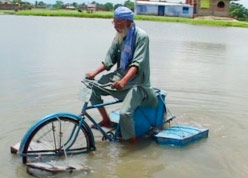
Water-Cycle : a grass-root innovation


I wrote previously about grassroot-innovations in India. Left side photo is about one of such inventions, a bicycle that can not-only travel on land but can also float on water.

Saturday, October 15, 2005

Visit rural Kerala to search for grassroot innovators

National Innovation foundation (NIF) is engaged in finding out rural innovators and help them with business practices of their inventions.

"Shodh yatra" mean : A Collective walk through the rainforests to learn from the creative communities and individuals.

16th shodh yatra will be held in Kerala (an Indian state known as "a Gods own country") during the end of december, 2005. More details can be seen here.

Raja
OSP India Information Security Prvate Limited (OSP Global, LLC)

Vacancies in NIF

National Innovation Foundation is the path breaking organization in supporting grass-root innovators of Rural India.

Currently NIF is looking for professionals (with aspiration towards rural development). Find more details here.

Raja
OSP India Information Security Prvate Limited (OSP Global, LLC)

Tuesday, May 10, 2005

Rural Innovations

National Innovation Foundation (India) in its website :
"......the time has come to unleash the creative potential of our scientists and innovators at grassroots level. Only then we can make India truly self-reliant and a leader in sustainable technologies....propose a national foundation for helping innovators all over the country. This fund...will build a national register of innovations, mobilize intellectual property protection, set up incubators for converting into viable business opportunities and help in dissemination across the country.''
Rural India is now in upswing with their creative innovations. Bicycle which runs on land as well as water. Washing Machine for Rs. 2000. What not!!

NIF's chanllenge is to link innovation, capital and enterprise. Its director, Gupta says, "We need mentors who can support these innovators. Most have no bank accounts. We need to give them design and marketing support, media coverage."

Find more innovations those can be marketed.

Raja
OSP India Information Security Prvate Limited (OSP Global, LLC)