The Nordic Council of Ministers is inviting applications for sustainable development grants.The deadline is 1 May.
Recently I wrote about "poor prefer private education". Here is a report that poor do get more benifit from private schools than their counter-parts.
According to a survey of egovernance projects, IT seems to be making higher impact in rural India compared to urban India. More details can be seen here.
Pico-hydro power generation is, a pilot project, to meet the energy needs of small communities in the hilly areas in Nepal (funded by UNDP).
INTERACT project (Sustainable Groundwater Management in Rural India) is a collaborative effort of several Indian research institutes with funding from UK's EPSRC. This research work is to enhance competitiveness in the field of Geoenvironmental Engineering, Sustainable groundwater management and Public Health issues.
Last year I wrote about Intel's project related to dust-free PC. Now Via technologies, with the support of IIT Bombay, developing a computer that can withstand erratic power supply and the heat and dust of rural places.
Tuesday, April 25, 2006


Cheaper 'blackberry' type gadget for rural india
Motorola (thro project at IIT Bombay) and Microsoft (independently) are developing a communication device using which "one can receive and make calls, check mails and use data services".
Rural India's market size in 2020 : $ 500 billion
Mckinsey recently surveyed rural India for Bharat Nirman project and concluded that rural India's market size in 2020 would be US $ 500 billion. According to survey: Of the 593 rural districts in India, 67 were classified as urban cousins, 118 close to rural economic centers, around 160 with basic minimum infrastructure and 248 are deprived.
Monday, April 10, 2006
Are you taking note of Green-Tech future?
According to this news:
Kleiner Perkins [Venture Capitalist firm] plans to set aside $100 million of its latest $600 million fund to technologies that help provide cleaner energy, transportation, air and water. "This field of green-tech could be the largest economic opportunity of the 21st century," Doerr said. "There’s never been a better time than now to start or accelerate a greentech venture."
Kleiner Perkins’ plan to ramp up investment in green technology is just the latest sign of the new sector’s growth. Also known as clean technology, the field includes technologies related to water purification, air quality, nanotechnology, alternative fuels, manufacturing, recycling and renewable energy.
North American venture capitalists invested more than $1.6 billion in clean-tech companies last year, a 35 percent increase over 2004, according to a report by the Cleantech Venture Network.
Wednesday, March 29, 2006
Water-Cycle : a grass-root innovation
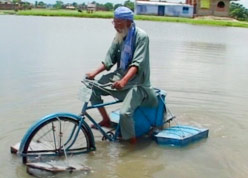
I wrote previously about grassroot-innovations in India. Left side photo is about one of such inventions, a bicycle that can not-only travel on land but can also float on water.
Food processing: Big corporates romancing with Rural India
According to this news:
My question is : will this move make sure that farmer gets benifited more than now?? Hope so.There are big plans being drawn up to link India’s farms to the world markets by companies, particularly those venturing into the domestic retail sector like Reliance, Godrej, Field Fresh (Sunil Mittal’s 50:50 joint venture with Rothschild), Snowman Frozen Food, a joint venture with the Mitsubishi group, Amalgam foods and HLL, Radhakrishna Group, DCM Sriram, Gufic Labs, Jain Irrigation, Tata Group, Godrej, Dabur, Blue Star and Voltas, among others.
Tax incentives being given by the government for food processing, including income tax and excise holidays for industries involved in the processing of fruits and vegetables have led to interest in the sector. These companies are establishing direct contact with farmers to source their requirements, by eliminating middlemen, and cutting down costs to offer higher yields to farmers.
Saturday, March 25, 2006
Are you a rural entrepreneur seeking funds?
Aavishkaar funds rural ventures that are commercially viable, improve the quality of life in rural people and needing Rs. 1 million to 5 Million. Check its website for more details.
Innovative distribution model for renewable energy in Bangladesh
According to this news:
With a loan in the form of a program-related investment (PRI) from The Lemelson Foundation, Emergence Energy is testing micro-entrepreneurship models for energy production and distribution in Bangladesh. Led by Iqbal Quadir, founder of Grameen Phone, and Dean Kamen, an accomplished inventor, Emergence Energy will combine access to micro-credit with low-cost energy generation technology to test whether rural entrepreneurs can sustainably manage mini power plants at the village level, making use of biogas and the stirling engine.
The proposed mini power plants will use cow manure as input and generate electricity, fertilizer, and heat as outputs. First, cow manure will be converted into methane-rich gas through a biogas business run by a local entrepreneur. This biogas will then be converted into electricity using a mini power plant owned and operated by two other entrepreneurs. All three entrepreneurs will be financed through a micro-credit program. These plants will generate a continuous power output of 1 KW and will supply energy for 70 advanced light bulbs, such as compact fluorescent lamps or light emitting diodes in their neighborhoods.
Friday, March 24, 2006
Deutsche Mutual Fund looking for companies focused on rural India
According to this news:
Deutsche Mutual Fund plans to turn its attention to companies focused on rural India, courtesy an equity fund titled Deutsche Green India Fund. The proposed scheme will try to generate long-term capital appreciation by investing chiefly in stocks of companies with businesses that revolve around the rural theme. These would also be companies that are expected to benefit from growth in agriculture and allied sectors. eutsche Green India Fund, to be benchmarked against the S&P CNX 500, will invest in companies engaged in agri commodities, irrigation, food processing, fertilisers, agri machinery, and the like.
Besides, rural infrastructure development companies (covering rural electrification, roads and canals) may also be included in the portfolio, along with tractor and two-wheeler makers. The fund's investment universe will include FMCG companies that derive a large part of their revenues from the rural market, while banks and finance outfits too will be taken into account. The offer document filed by Deutsche MF with the SEBI has named Vinay Kulkarni as the fund manager. A minimum 65 per cent of the assets will be invested in equities and equity-related securities of companies that focus on rural India. The allocation may be raised to 100 per cent as well.
Reliance Agri Fund, which Reliance MF had mooted last month, has been a first of sorts on this front although Sundaram MF has actually entered the market with its Rural India Fund. If launched, Reliance Agri will follow Reliance Equity, whose NFO recently wrapped up with Rs 5,700 crore. The fund's investments may span 0-100 per cent in equity as well as 0-100 per cent in debt. The idea, as outlined in the offer document, is to invest in equity or fixed income securities of companies in the agri sector and those in allied segments.
Thursday, March 23, 2006
Yahoo! India is eyeing rural India
According to this news:
Dr Prasad Ram, CTO, Yahoo! R&D India, said that `livelihood-based' offerings for the rural market would roll out by mid-2006.
Indian engineers [at Yahoo!] have contributed eight products to the global market. Three of them - Vertical Search, Personalised Anti-Spam Filters and Self Expression - were created, developed and completed here. While the first service offers Internet users the ability to narrow down their search in verticals such as travel, real estate, shopping and automotives, the second works on the premise that people have discrete definitions of spam. By studying their reaction to spam in their inbox, Yahoo! Mail will now be able to `learn' to minimise it using personalised filters. The third product, Self Expression, is a personalised Web page that will be "rich with self expression".. The company underwent a "rethinking of products" for rural markets. Dr Ram spoke about the probability of people in remote villages and towns adopting e-shopping, since they have limited access to shops. The company is presently undertaking the implementation rounds of the services. Pilot tests would begin in January, he added.
Development of rural enterprises -- China's secret
A book is edited by He Kang and written by experts in this field. According to this news:
This book details the rise and development of TVEs - a leading force that has propelled China's market economy forward, a vital pillar of the rural economy and an important component of the national economy.According to data contained in the book, the number of rural enterprises stood at more than 22.13 million, they employed more than 138.66 million people, making a great contribution to the national economic development and social stability. The book, in English and 436 pages, presents both a general picture and personal profiles of farmer-turned entrepreneurs, with detailed feature stories.
Well supported by a rich collection of data, graphics and statistics updated to 2004, easily accessible reference with well-indexed names and terms peculiar to China, the book is considered suitable for researchers into the Chinese economy, especially that of rural China, Chinese farmers and agriculture, as well as for anyone who wants a peep at the secrets of China's rapid economic growth.
Title of the Book: China's Township and Village Enterprises
Publisher: Foreign Languages Press, Beijing
Monday, March 20, 2006
Rural Indian been running a radio station and seeking help
According to this news:
Everyone is hooked to Raghav Station in a dusty village in the eastern Bihar, one of India's most backward and impoverished states. The radio station, hugely popular with the residents of Mansoorpur - a non-descript village in Muzaffarpur district, is the brainchild of a local youth Raghav Kumar.
Twenty-two-year-old Kumar, a self-taught radio mechanic, can hardly read and write, but all the programmes on his radio station have struck a chord with the local residents for the past three years. Kumar's passion for doing something creative and unique has remained undeterred by his illiteracy and poverty.
Kumar has ingeniously fitted his transmission kit - a box strung to antenna to a bamboo pole connecting at least three tape-recorders in his thatched-roof repair shop stacked with over 200 audio tapes and electronic appliances. The station plays folk songs and popular Bollywood music. It also broadcasts public interest messages on polio and HIV on requests from social organisations - all without charging a single penny.
The station's popularity has clearly given other FM channels a run for their money within the 15 km radius of Kumar's shop. Everyone listens to the Raghav Station. We take the radio along when we go to work in our fields and listen to the songs while working. Our families also listen to the songs, says Ram Prasad Bhagat, a villager.
The indigenous radio station, however, has yet to find favour from the government, as it has no statutory licence to run such a station. Kumar says with his meagrely monthly income of 2000 rupees (US dollars 45), he cannot pay the registration fees. Kumar seeks government aid to help him register his station and to acquire some advanced equipment to transmit the radio waves to a greater distance.
Everyone is hooked to Raghav Station in a dusty village in the eastern Bihar, one of India's most backward and impoverished states. The radio station, hugely popular with the residents of Mansoorpur - a non-descript village in Muzaffarpur district, is the brainchild of a local youth Raghav Kumar.
Twenty-two-year-old Kumar, a self-taught radio mechanic, can hardly read and write, but all the programmes on his radio station have struck a chord with the local residents for the past three years. Kumar's passion for doing something creative and unique has remained undeterred by his illiteracy and poverty.
Kumar has ingeniously fitted his transmission kit - a box strung to antenna to a bamboo pole connecting at least three tape-recorders in his thatched-roof repair shop stacked with over 200 audio tapes and electronic appliances. The station plays folk songs and popular Bollywood music. It also broadcasts public interest messages on polio and HIV on requests from social organisations - all without charging a single penny.
The station's popularity has clearly given other FM channels a run for their money within the 15 km radius of Kumar's shop. Everyone listens to the Raghav Station. We take the radio along when we go to work in our fields and listen to the songs while working. Our families also listen to the songs, says Ram Prasad Bhagat, a villager.
The indigenous radio station, however, has yet to find favour from the government, as it has no statutory licence to run such a station. Kumar says with his meagrely monthly income of 2000 rupees (US dollars 45), he cannot pay the registration fees. Kumar seeks government aid to help him register his station and to acquire some advanced equipment to transmit the radio waves to a greater distance.
Sunday, March 19, 2006
Rural Employment Scheme : yet another political gimmick
Recent proposal : National Rural Employment Guarantee Scheme by the current government is a mere political gimmick. This is another scheme which increases the appetite of already-corrupt-administration. Rural youth require jobs creation but not wastage of public money like this.
You may see more detailed analysis : Atanu Dey, Economic Times, Business Today.
You may see more detailed analysis : Atanu Dey, Economic Times, Business Today.
Mutual Fund is after companies focussing rural
According to this news:
Related news: Khosla interested in companies serving rural
Sundaram Mutual Fund has unveiled its new equity offering under open-ended category, Sundaram Rural India Fund.
The primary investment objective of the scheme is to generate consistent long-term returns by investing predominantly in equity & equity related instruments of companies that are focusing on Rural India.
The new fund offer opens on March 20, 2006 and will close on April14, 2006. Minimum subscription amount is Rs 5,000 and offers both dividend and growth option. During new fund offer it would not charge any entry load while an exit load of 3 per cent would be levied if redeemed within six months from the date of allotment.
Related news: Khosla interested in companies serving rural
Thursday, March 16, 2006
Hyderabad university admits school drop-outs
Please see this news. Hyderabad University train school drop-outs so that they can be viable for industry.
No rain but vegetables can be grown : IIM prof feat
According to this news:
Vegetables growing in arid land is unheard of. But this impossible task has been made possible by IIMA professor Dr Girija Sharan. For the past three years, people of Kothara village in Kutch enjoy fresh tomatoes and capsicums grown at a greenhouse farm here. Now, even nearby areas including IAF base at Nalia come here for their greens.Raja
The credit goes to Dr Sharan who designed the Arid Area Greenhouse (AAG), a cultivation technology that departs from the traditional open farms and makes use of the greenhouse’s controlled enviroment to grow vegetables in a place where water is scarce.
Tuesday, March 14, 2006
Khosla : Looking for investments in sustainable technologies
Vinod Khosla is looking to invest into energy, micro-finance and bottom of the pyramid among others. See his new exclusive venture fund for this.
This is a great news for social entrepreneurs in India.
Raja
This is a great news for social entrepreneurs in India.
Raja
Monday, March 13, 2006
Poor parents prefer private schools: Why?
This survey research paper answers the following interesting question.
Q. Why would these largely poor parents pay for their child’s education when there is a free government alternative?
1) The private schools are having English medium which is a very important factor to the 96% of the parents.
2) Parents perceive that the private sector provides a better quality of education
3) 98% of the parents indicate the fact that the school is considered to be a ‘good educational provider’ is an important element when they chose their child’s school.
4) Almost 75% of the parents stated that it was unimportant to them if there was a government alternative to which they could send their children They would choose the private school irrespective of the provision of a government school.
5) 78% of the parents stated that they would recommend their current private school to their neighbours, friends or relatives.
6) 93% of the parents rated their private school “very good” or “good” value for money.
7) School owners face 3 or more major competing schools in their area. Local government school is never a competitor. (most owners expressed this!)
8) School official: the teachers in the private unaided schools are accountable to the parents. On the other hand, govt schools teachers and staff are guaranteed a ‘job for life’ owing to the strength of the teachers’ unions and employment contracts.
9) Parents are attracted to private schools glossy brochure and the manager’s office had marble floors and air conditioning ( however class-rooms are no different in schools which charge less or high).
10) ‘Recognised’ by the state Government (thro bribery: even this fact is known to parents).
11) Internal tests in private schools were deliberately providing easier tests to inflate their scores, thus encouraging parents to believe that they were better.
Q. Why would these largely poor parents pay for their child’s education when there is a free government alternative?
1) The private schools are having English medium which is a very important factor to the 96% of the parents.
2) Parents perceive that the private sector provides a better quality of education
3) 98% of the parents indicate the fact that the school is considered to be a ‘good educational provider’ is an important element when they chose their child’s school.
4) Almost 75% of the parents stated that it was unimportant to them if there was a government alternative to which they could send their children They would choose the private school irrespective of the provision of a government school.
5) 78% of the parents stated that they would recommend their current private school to their neighbours, friends or relatives.
6) 93% of the parents rated their private school “very good” or “good” value for money.
7) School owners face 3 or more major competing schools in their area. Local government school is never a competitor. (most owners expressed this!)
8) School official: the teachers in the private unaided schools are accountable to the parents. On the other hand, govt schools teachers and staff are guaranteed a ‘job for life’ owing to the strength of the teachers’ unions and employment contracts.
9) Parents are attracted to private schools glossy brochure and the manager’s office had marble floors and air conditioning ( however class-rooms are no different in schools which charge less or high).
10) ‘Recognised’ by the state Government (thro bribery: even this fact is known to parents).
11) Internal tests in private schools were deliberately providing easier tests to inflate their scores, thus encouraging parents to believe that they were better.
Packaged Rural Foods & a business plan
For the past 10 years, I usually carry hot (Namkeen or Junk Food) (I also carry sweets, but this article is limited to hot varieties) made in my home to my university. Whenever I took such items, all of my friends greatly enjoyed over and above sweets. Till date, I have never seen such wide varieties of items in any city I stayed in India (Chennai, Kolkata, Mumbai). I had at least 100 different tasty foods in my own home. And I believe there could be even more items.
Usually these foods are made of rice (main ingredient) (rarely wheat), Dals (pulses), masala chilli powder and some other stuff. Good part of them is that they stay for longer without any preservatives (longer I mean, more than 3 months if packaged).
There is a good market for such items in India and elsewhere in the world. In India, there are very few companies in this domain notably Haldiram. However haldiram's business is limited to few items (10-15 types : and all are not much different in taste).
Rural India can do a lot in this space. In fact, there are some similar packaged items in Japan originating from rural places of Japan.
Raja
OSP India Information Security Private Limited
Usually these foods are made of rice (main ingredient) (rarely wheat), Dals (pulses), masala chilli powder and some other stuff. Good part of them is that they stay for longer without any preservatives (longer I mean, more than 3 months if packaged).
There is a good market for such items in India and elsewhere in the world. In India, there are very few companies in this domain notably Haldiram. However haldiram's business is limited to few items (10-15 types : and all are not much different in taste).
Rural India can do a lot in this space. In fact, there are some similar packaged items in Japan originating from rural places of Japan.
Raja
OSP India Information Security Private Limited
Subscribe to:
Posts (Atom)